Subgenus Hoplosmia
The subgenus Hoplosmia Thomson is confined to the Palaearctic region. It contains 21 species (Müller, 2018a).
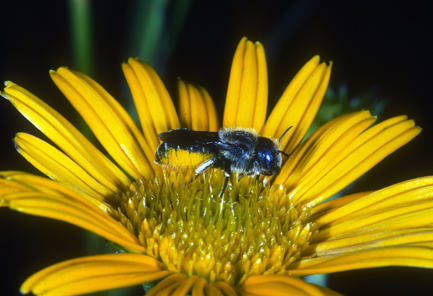
Female of Osmia (Hoplosmia) spinulosa (Kirby, 1802) collecting pollen on a flower head of Buphthalmum salicifolium (Asteraceae). Foto A. Müller.
Species accounts
spinulosa species group
Osmia (Hoplosmia) carbo (Zanden, 1994)
1994 Hoplosmia (Paranthocopa) pinguis carbo Zanden, Linzer Biologische Beiträge, 26: 1116. Type material: Holotype f, “8 km O Yeroham” [Israel], Schwarz Collection (Ansfelden); paratypes mm, ff.-Osmia carbo (Zanden) stat. nov. in Müller (2018a).
Distribution-Northern Africa: ET. Southwestern Asia: IL, JOR, SYR.
Identification-Keys, Descriptions: Müller (2018a).
Nesting biology-Nesting site: Preexisting cavities: empty snail shells of small to medium size with 1-3 brood cells. Similar to O. spinulosa, the nests are not sealed against their rear end with a basal wall and the outermost cell partition is distinctly more robust than all the other cell partitions and the nest plug, probably acting as a barrier against parasites and predators. In contrast to O. spinulosa, the shells are never turned after they have been sealed. Nesting material: Cell partitions and nest plug are made of chewed leaves. The shell surface is not plastered with patches of leaf pulp. (Müller, 2018a and references therein)
Flower preferences: Oligolectic on Asteraceae with a near exclusive preference for Cichorioideae and Asteroideae; Carduoideae are very rarely exploited as well (Müller, 2018a).
Osmia (Hoplosmia) centaureae Müller, 2018
2018 Osmia (Hoplosmia) centaureae Müller, Zootaxa, 4415: 303. Type material: Holotype m, “Wadi Mujib, King’s Highway” [Jordan], ETHZ (Zurich); paratypes mm, ff.
Distribution-Southwestern Asia: IL, JOR.
Identification-Keys, Descriptions: No supplementary or more detailed morphological description known.
Nesting biology: Unknown.
Flower preferences: Oligolectic on Asteraceae with a probably exclusive preference for Carduoideae (Müller, 2018a).
Osmia (Hoplosmia) croatica Friese, 1893
1893 Osmia croatica Friese, Entomologische Nachrichten (Berlin), 19: 353. Type material: Lectotype m, by designation of Tkalcu (1974a: 123), “Triest” [Italy], ZMHB (Berlin).-Combination Anthocopa (Hoplosmia) croatica (Friese) in Tkalcu (1974a: 122). Combination Hoplosmia (Hoplosmia) croatica (Friese) in Ungricht et al. (2008: 131).
Distribution-Europe: BG, GR, GR(Aegean Islands), HR, I, SCG, SLO. Southwestern Asia: TR.
Identification-Keys, Descriptions: Ducke (1900); Stanek (1969a: 19-22); Tkalcu (1974a); Müller (2018a).
Nesting biology-Nesting site: Preexisting cavities: empty snail shells. The only nest recorded so far contained a single brood cell and was hidden below stones. The nest architecture appears to be exactly the same as in Osmia (Hoplosmia) spinulosa. Nesting material: Cell partitions and nest plug are made of chewed leaves (e.g. from Scabiosa). The shell surface is not plastered with patches of leaf pulp. (A. Müller, 2018a)
Flower preferences: Oligolectic on Asteraceae with a probably exclusive preference for Carduoideae (Müller, 2018a).
Osmia (Hoplosmia) elegans (Tkalcu, 1992)
1992 Hoplosmia (Hoplosmia) elegans Tkalcu, Acta Societatis Zoologicae Bohemoslovacae (Praha), 56: 220. Type material: Holotype m, “Side” [Turkey], RMNH (Leiden); paratypes m(m), f(f).
Distribution-Europe: GR(Lesbos). Southwestern Asia: JOR, TR.
Identification-Keys, Descriptions: Müller (2018a).
Nesting biology: Unknown.
Flower preferences: The only pollen load analyzed so far consisted of pollen of Carduoideae (Asteraceae) (Müller, 2018a).
Osmia (Hoplosmia) fallax Pérez, 1895
1895 Osmia fallax Pérez, Espèces nouvelles de mellifères de Barbarie, p. 13. Type material: Lectotype m, by designation of Tkalcu (1974a: 131), “Andalusia” [Spain], MNHN (Paris). Type species of Odonterythrosmia Tkalcu.-Combination Anthocopa (Odonterythrosmia) fallax (Pérez) in Tkalcu (1974a: 131). Combination Hoplosmia (Odontanthocopa) fallax (Pérez) in Ungricht et al. (2008: 134).
Distribution-Europe: E. Northern Africa: DZ, MA.
Identification-Keys, Descriptions: Ducke (1900); Tkalcu (1974a); Müller (2018a).
Nesting biology-Nesting site: Preexisting cavities: empty snail shells (e.g. Sphincterophila candidissima) with 1-4 cells per shell. Nesting material: Unknown. (Müller, 2018a and references therein). Brood parasites: possibly Stelis odontopyga (Hymenoptera, Megachilidae) (Moreno-Rueda et al., 2008; Müller, 2018a).
Flower preferences: Polylectic with a strong preference for Cistaceae (e.g. Helianthemum), additional pollen sources include Brassicaceae, Asteraceae (Asteroideae, Cichorioideae), Echium (Boraginaceae) and Lamiaceae (Müller, 2018a).
Osmia (Hoplosmia) picena (Tkalcu, 1999)
1999 Hoplosmia (Hoplosmia) picena Tkalcu, Bulletin de la Société Entomologique de Mulhouse, Janvier-Mars: 11. Type material: Holotype f, “P.N. Sibillini” [Italy], RMNH (Leiden); paratypes ff.
Distribution-Europe: I.
Identification-Keys, Descriptions: Müller (2018a).
Nesting biology: Unknown.
Flower preferences: Oligolectic on Asteraceae with a preference for Carduoideae; species of the Cichorioideae and the Asteroideae are occasionally also exploited as pollen sources (Müller, 2018a).
Osmia (Hoplosmia) pinguis Pérez, 1895
1895 Osmia pinguis Pérez, Espèces nouvelles de mellifères de Barbarie, p. 12. Type material: Lectotype f, by designation of Tkalcu (1974a: 133), “Da Calle” [Algeria], MNHN (Paris). Type species of Paranthocopa Tkalcu.-Combination Anthocopa (Paranthocopa) pinguis (Pérez) in Tkalcu (1974a: 133). Combination Hoplosmia (Paranthocopa) pinguis (Pérez) in Ungricht et al. (2008: 136).
1928 Osmia indivisa Benoist, Bulletin de la Société des Sciences Naturelles du Maroc (Rabat), 8: 214. Type material: Holotype m, “Marrakech” [Morocco], MNHN (Paris).-Synonymy in Zanden (1985: 55).
Distribution- Europe: E. Northern Africa: DZ, MA, TN.
Identification-Keys, Descriptions: Ducke (1900); Tkalcu (1974a); Müller (2018a).
Nesting biology-Nesting site: Preexisting cavities: empty snail shells of small to medium size (e.g. Otala, Rumina) with 2-4 brood cells per shell. Similar to O. spinulosa, the nests are not sealed against their rear end with a basal wall and the outermost cell partition is distinctly more robust than all the other cell partitions and the nest plug, probably acting as a barrier against parasites and predators. In contrast to O. spinulosa, the shells are never turned after they have been sealed. Nesting material: Cell partitions and nest plug are made of chewed leaves. The shell surface is not plastered with patches of leaf pulp. (Müller, 2018a and references therein)
Flower preferences: Oligolectic on Asteraceae with a near exclusive preference for Cichorioideae and Asteroideae (Müller, 2018a).
Osmia (Hoplosmia) spinigera Latreille, 1811
1811 Osmia spinigera Latreille, Encyclopédie Méthodique, Histoire Naturelle, Insectes, vol. 8, p. 584. Type material: Syntypes m(m), f(f), “Égypte” [Egypt], Olivier Collection.-Combination Anthocopa (Hoplosmia) spinigera (Latreille) in Tkalcu (1974a: 122). Combination Hoplosmia (Hoplosmia) spinigera (Latreille) in Ungricht et al. (2008: 131).
1869 Osmia clavicula Gerstaecker, Entomologische Zeitung (Stettin), 30: 347. Type material: Lectotype m, by designation of Tkalcu (1974a: 122), “Naxos” [Greece], ZMHB (Berlin).-Synonymy in Tkalcu (1974a: 122).
Distribution-Europe: BG, GR, GR(Aegean Islands), MK. Northern Africa: ET. Southwestern Asia: IL, IRQ, JOR, RL, SYR, TR.
Identification-Keys, Descriptions: Ducke (1900); Mavromoustakis (1948b: 216, 1959: 297-298); Tkalcu (1974a); Müller (2018a).
Nesting biology-Nesting site: Preexisting cavities: empty snail shells of medium size (e.g. Theba). Nesting material: Cell partitions and nest plug are made of chewed leaves. (Müller, 2018a and references therein)
Flower preferences: Oligolectic on Asteraceae with a near exclusive preference for Carduoideae; species of the Cichorioideae and Asteroideae are very rarely exploited as pollen sources as well (Müller, 2018a).
Osmia (Hoplosmia) spinulosa (Kirby, 1802)
1802 Apis spinulosa Kirby, Monographia Apum Angliae, 2: 261. Type material: Lectotype m, by designation of Tkalcu (1974a: 119), [United Kingdom], BMNH (London); paralectotypes m, ff. Type species of Hoplosmia Thomson.-Combination Pseudosmia spinulosa (Kirby) in Radoszkowski (1874c: 159). Combination Anthocopa (Hoplosmia) spinulosa (Kirby) in Tkalcu (1974a: 119). Combination Hoplosmia (Hoplosmia) spinulosa (Kirby) in Ungricht et al. (2008: 131).
1882 Osmia euchreiformis Radoszkowski, Proceedings of the Warsaw Society of Naturalists, Bulletin of Biology, 2: 77 [not seen]. Type material: Holotype m, “Echmiadzin” [Armenia], ZMHB (Berlin).-Synonymy in Tkalcu (1974a: 119).
Distribution-Europe: A, AND, ARM, B, BG, BIH, CH, CZ, D, DK, E, F, FL, GB, GE, H, HR, I, I(Sa), I(Si), L, MD, MK, N, NL, PL, RO, RUS(CR,SR), S, SCG, SK, SLO, UA, UA(Crimea). Northern Asia: KS, KZ, RU(WS,ES), RUS(WS), TJ. Southwestern Asia: TR.
Identification-Keys, Descriptions: Amiet et al. (2004); Banaszak and Romasenko (2001); Benoist (1931); Ducke (1900); Mavromoustakis (1959: 298); Medvedeva (1978); Móczár (1958); Radoszkowski (1874c: 159, 1887a: 282-283); Scheuchl (1996); Schmiedeknecht (1885-1886); Tkalcu (1974a, 1992: 220-221); Müller (2018a).
Nesting biology-Nesting site: Preexisting cavities: empty snail shells of small to medium size (e.g. Cepaea, Cornuella, Fruticicola, Helicella, Pomatias, Xerolenta, Zebrina, small shells of Helix) with 1-3, mostly 2 cells per shell. The nests are not sealed against their rear end with a basal wall and the outermost cell partition is distinctly more robust than all the other cell partitions and the nest plug, probably acting as a barrier against parasites and predators. The closed shells are not transported but turned so that the shell opening is directed towards the ground. Nesting material: Cell partitions and nest plug are made of chewed leaves (e.g. from Potentilla, Sanguisorba). The shell surface is not plastered with patches of leaf pulp. (Müller, 2018a and references therein). Brood parasites: Stelis odontopyga (Hymenoptera, Megachilidae), Chrysura cuprea and C. trimaculata (Hymenoptera, Chrysididae), Melittobia acasta (Hymenoptera, Eulophidae), Pteromalus apum and P. venustus (Hymenoptera, Pteromalidae) and Anthrax aethiops (Diptera, Bombyliidae) (Blüthgen, 1926; Noskiewicz, 1926; Kunz, 1994; Müller, 1994; BWARS, 2013).
Flower preferences: Oligolectic on Asteraceae; pollen host plants include members of the Carduoideae, the Cichorioideae and the Asteroideae (Müller, 2018a).
Osmia (Hoplosmia) tyrneri (Tkalcu, 1992)
1992 Hoplosmia (Hoplosmia) tyrneri Tkalcu, Acta Societatis Zoologicae Bohemoslovacae (Praha), 56: 220. Type material: Holotype m, “Tashkent, Galvasai” [Uzbekistan], Tyrner Collection (Litvinov); paratypes mm.
Distribution-Northern Asia: KZ, UZ.
Identification-Keys, Descriptions: Müller (2018a).
Nesting biology: Oligolectic on Asteraceae; pollen host plants include members of the Cichorioideae and more rarely of the Carduoideae and the Asteroideae (A. Müller, unpublished, based on 15 pollen loads from 2 different localities).
Flower preferences: Unknown.
bidentata species group
Osmia (Hoplosmia) anceyi Pérez, 1879
1879 Osmia Anceyi Pérez, Actes de la Société Linnéenne de Bordeaux, 33: 187. Type material: Lectotype f, by designation of Tkalcu (1974a: 128), “Environs de Marseille” [France], MNHN (Paris).- Combination Anthocopa (Odontanthocopa) anceyi (Pérez) in Tkalcu (1974a: 128). Combination Hoplosmia (Odontanthocopa) anceyi (Pérez) in Ungricht et al. (2008: 132).
Distribution-Europe: CH, E, F, F(Co), P. Northern Africa: DZ, MA, TN.
Identification-Keys, Descriptions: Amiet et al. (2004); Benoist (1931); Schmiedeknecht (1885-1886); Tkalcu (1974a); Müller (2018a).
Nesting biology-Nesting site: Preexisting cavities: insect burrows in dead wood, dead hollow plant stems, burrows in the pith of dead stems (e.g. Asphodelus) excavated by other aculeates (e.g. Ceratina) or abandoned nests of aculeate hymenopterans in clay walls. The nests contain up to nine linearly arranged brood cells. Nesting material: Cell partitions and nest plug are made of mud, sometimes mixed with particles of pith. (Müller, 2018a and references therein)
Flower preferences: Oligolectic on Asteraceae with a probably exclusive preference for Carduoideae (Müller, 2018a).
– subspecies anceyi Pérez, 1879
1879 Automatically established nominotypical subspecific taxon (original description and type specimen are identical with those of the species rank taxon of the same name above).
Distribution-Europe: CH, E, F, P.
Identification-Keys, Descriptions: Müller (2018a).
– subspecies biarmica (Zanden, 1994)
1994 Hoplosmia (Odontanthocopa) anceyi biarmica Zanden, Linzer Biologische Beiträge, 26: 1114. Type material: Holotype f, “Tizi-n-Tichka S., 2000 m” [Morocco], Schwarz Collection (Ansfelden); paratypes mm, ff.
Distribution-Northern Africa: DZ, MA, TN.
Identification-Keys, Descriptions: Müller (2018a).
Osmia (Hoplosmia) bidentata Morawitz, 1875
1875 Osmia bidentata Morawitz, Horae Societatis Entomologicae Rossicae (St. Petersburg), 12: 38. Type material: Syntypes m(m), f(f), “Etschmiadzin” [Armenia]. Type species of Odontanthocopa Tkalcu.-Combination Anthocopa (Odontanthocopa) bidentata (Morawitz) in Tkalcu (1974a: 127). Combination Hoplosmia (Odontanthocopa) bidentata (Morawitz) in Ungricht et al. (2008: 133).
1877 Osmia affinis Frivaldsky, Mathematikai és Természettudományi Közlemények, 13: 360. Type material: Syntypes m(m), f(f), “In Comitatu Crassoviensi ad Oraviczam, in Comitatu Pestiensi vero ad Budapestinum et in Praedio-Peszér” [Hungary].-Synonymy in Tkalcu (1974a: 127).
Distribution-Europe: A, AL, ARM, AZ, BG, CZ, F, GR, GR(Aegean Islands, Cr), H, HR, I, MK, PL, RO, RUS(CR,SR), SCG, SK, SLO, UA, UA(Crimea). Northern Africa: ET. Southwestern Asia: IL, IR, IRQ, JOR, RL, SYR, TR.
Identification-Keys, Descriptions: Alfken (1914: 197); Banaszak and Romasenko (2001); Benoist (1931); Ducke (1900); Medvedeva (1978); Móczár (1958); Romankova (1995); Scheuchl (1996); Schmiedeknecht (1885-1886); Tkalcu (1974a, 1992: 225); Müller (2018a).
Nesting biology-Nesting site: Preexisting cavities: insect burrows in dead wood, hollow stems (e.g. Phragmites) or cavities in the soil, possibly also abandoned nests of aculeates in loess scarps. The nests contain 1-11 linearly arranged brood cells. Nesting material: Cell partitions and nest plug are made of mud. (Müller, 2018a and references therein; Ivanov et al., 2019)
Flower preferences: Oligolectic on Asteraceae with a probably exclusive preference for Carduoideae (A. Müller, 2018a). In contrast, Güler & Sorkun (2007) assume O. bidentata to be polylectic, harvesting pollen from eleven plant families.
– subspecies bidentata Morawitz, 1875
1875 Automatically established nominotypical subspecific taxon (original description and type specimen are identical with those of the species rank taxon of the same name above).
Distribution-Europe: A, AL, ARM, BG, CZ, GR, GR(Cr), H, HR, I, MK, PL, RO, RUS(CR,SR), SCG, SK, SLO, UA, UA(Crimea).
Identification-Keys, Descriptions: Tkalcu (1979: 320); Müller (2018a).
– subspecies pallens (Tkalcu, 1979)
1979 Anthocopa (Odontanthocopa) bidentata pallens Tkalcu, Acta Entomologica Bohemoslovaca (Praha), 76: 320. Type material: Holotype f, “Erzurum” [Turkey], EMET (Erzurum); paratypes mm, ff.-Combination Hoplosmia (Odontanthocopa) bidentata pallens (Tkalcu) in Ungricht et al. (2008: 133).
Distribution-Europe: AZ, GR(Lesbos). Northern Africa: ET. Southwestern Asia: IL, IR, IRQ, JOR, SYR, TR.
Identification-Keys, Descriptions: Müller (2018a).
ligurica species group
Osmia (Hoplosmia) dido Gribodo, 1894
1894 Osmia dido Gribodo, Bullettino della Società Entomologica Italiana, 26: 289. Type material: Holotype f, “Algeria” [Algeria], MSNG (Genova).-Combination Anthocopa dido (Gribodo in Zanden (1990: 54). Combination Hoplosmia (Odontanthocopa) dido (Gribodo) in Ungricht et al. (2008: 133).
1895 Osmia abbreviata Pérez, Espèces nouvelles de mellifères de Barbarie, p. 13. NOMEN PRAEOCCUPATUM [not Osmia abbreviata Morawitz, 1875]. Type material: Lectotype f, by designation of Tkalcu (1974a: 128), “Algéria” [Algeria], MNHN (Paris).-Synonymy in Zanden (1990: 54).
1896 Osmia compacta Pérez, Correctures: Espèces nouvelles de mellifères de Barbarie, not paginated single page appendix to Pérez (1895). NOMEN NOVUM with same type specimen for preoccupied Osmia abbreviata Pérez, 1895 [not Osmia abbreviata Morawitz, 1875].-Combination Anthocopa (Odontanthocopa) compacta (Pérez) in Tkalcu (1974a: 128).
Distribution-Northern Africa: DZ, MA, TN.
Identification-Keys, Descriptions: Alfken (1914: 197); Tkalcu (1974a, 1979: 320-321); Müller (2018a).
Nesting biology: Unknown.
Flower preferences: Probably oligolectic on Asteraceae with a strong or even exclusive preference for Carduoideae (Müller, 2018a).
Osmia (Hoplosmia) distinguenda (Tkalcu, 1974)
1974 Anthocopa (Odontanthocopa) distinguenda Tkalcu, Acta Entomologica Bohemoslovaca (Praha), 71: 129. Type material: Holotype m, “Jerusalem” [Israel], BMNH (London).-Combination Hoplosmia (Odontanthocopa) distinguenda (Tkalcu) in Ungricht et al. (2008: 134).
Distribution-Europe: ARM, AZ, GR. Southwestern Asia: IL, IRQ, JOR, RL, SYR, TR.
Identification-Keys, Descriptions: Tkalcu (1979: 320-321, 1992: 223-224).
Nesting biology-Nesting site: Preexisting cavities: small cavities in rocks and stones. Nesting material: Brood cells entirely or partially built from chewed leaves, nest plug also made of leaf pulp. (Müller, 2018a and references therein)
Flower preferences: Oligolectic on Asteraceae with a strong or even exclusive preference for Carduoideae (A. Müller, 2018a).
Osmia (Hoplosmia) hermonensis (Tkalcu, 1992)
1992 Hoplosmia (Odontanthocopa) hermonensis Tkalcu, Acta Societatis Zoologicae Bohemoslovacae (Praha), 56: 223. Type material: Holotype m, “Mt. Hermon, 1700 m” [Israel], RMNH (Leiden); paratypes mm.
Distribution-Southwestern Asia: IL.
Identification-Keys, Descriptions: Müller (2018a). Note: Female unknown.
Nesting biology: Unknown.
Flower preferences: Unknown.
Osmia (Hoplosmia) larochei Tkalcu, 1993
1993 Osmia (Odontanthocopa) larochei Tkalcu, Veröffentlichungen des Übersee-Museum Bremen (Naturwissenschaften), 12: 810. Type material: Holotype f, “Gran Canaria Cueva Grande Las Palmas” [Spain: Canary Islands], La Roche Collection; paratype f.-Combination Hoplosmia (Odontanthocopa) larochei (Tkalcu) in Ungricht et al. (2008: 134).
Distribution-Northern Africa: E(Ca).
Identification-Keys, Descriptions: Tkalcu (2000a: 310); Müller (2018a).
Nesting biology: Unknown.
Flower preferences: Unknown. Flower record: Andryala pinnatifolia (Asteraceae) (Hohmann et al., 1993).
Osmia (Hoplosmia) ligurica Morawitz, 1868
1868 Osmia ligurica Morawitz, Horae Societatis Entomologicae Rossicae (St. Petersburg), 5: 150. Type material: Syntypes m(m), f(f), “Bei Nizza im Thale des Paglione” [France].-Combination Anthocopa (Odontanthocopa) ligurica (Morawitz) in Tkalcu (1974a: 130). Combination Hoplosmia (Odontanthocopa) ligurica (Morawitz) in Ungricht et al. (2008: 135).
1879 Osmia detrita Pérez, Actes de la Société Linnéenne de Bordeaux, 33: 188. Type material: Lectotype f, by designation of Tkalcu (1974a: 130), “Bordeaux, Marseille” [France], MNHN (Paris).-Synonymy in Schmiedeknecht (1886: 199 [1065]).
Distribution-Europe: A, AL, ARM, AZ, BG, CH, CZ, E, E(Ba), F, F(Co), GE, GR, GR(Aegean Islands, Cr), H, HR, I, I(Sa), I(Si), P, MK, RO, RUS(SR), SCG, SK, SLO. Northern Africa: MA. Northern Asia: TM. Southwestern Asia: CY, IL, IR, IRQ, JOR, SYR, TR.
Identification-Keys, Descriptions: Amiet et al. (2004); Banaszak and Romasenko (2001); Benoist (1931); Ducke (1900); Medvedeva (1978); Móczár (1958); Schmiedeknecht (1885-1886); Tkalcu (1974a, 1992: 223); Müller (2018a).
Nesting biology-Nesting site: Preexisting cavities: dead hollow stems or burrows in pithy stems (e.g. Artemisia, Foeniculum, Rubus, Scolymus) excavated by other aculeates (e.g. Ceratina). The nests contain up to 8 linearly arranged brood cells. Nesting material: Cell partitions and nest plug are made of chewed leaves. (Müller, 2018a and references therein)
Flower preferences: Oligolectic on Asteraceae with a preference for Asteroideae; species of the Cichorioideae are also exploited (Müller, 2018a).
Osmia (Hoplosmia) olgae (Tkalcu, 1978)
1978 Anthocopa (Odontanthocopa) olgae Tkalcu, Casopis Slezskeho Muzea Opava (A), 27: 159. Type material: Holotype m, “Bulgaria sept.-or. Albena” [Bulgaria], Tkalcu Collection (Praha); paratypes mm, ff.-Combination Hoplosmia (Odontanthocopa) olgae (Tkalcu) in Ungricht et al. (2008: 135).
Distribution-Europe: BG. Southwestern Asia: TR.
Identification-Keys, Descriptions: Müller (2018a).
Nesting biology: Unknown.
Flower preferences: Unknown. The only two pollen loads analyzed so far consisted of pollen of Asteroideae (Asteraceae) (Müller, 2018a).
Osmia (Hoplosmia) padri (Tkalcu, 1974)
1974 Anthocopa (Odontanthocopa) padri Tkalcu, Acta Entomologica Bohemoslovaca (Praha), 71: 129. Type material: Holotype f, “Slancev Brjag” [Bulgaria], Pádr Collection (Praha); paratypes mm, ff.-Combination Hoplosmia (Odontanthocopa) padri (Tkalcu) in Ungricht et al. (2008: 135).
Distribution-Europe: BG, GR, GR(Aegean Islands), HR, MK, SCG. Southwestern Asia: IL, IRQ, SYR, TR.
Identification-Keys, Descriptions: Tkalcu (1979: 321); Müller (2018a).
Nesting biology-Nesting site: Preexisting cavities: insect burrows in dead wood. Nesting material: Unknown. (Müller, 2018a and references therein)
Flower preferences: Oligolectic on Asteraceae with a probably exclusive preference for Carduoideae (Müller, 2018a).
Osmia (Hoplosmia) scutellaris Morawitz, 1868
1868 Osmia scutellaris Morawitz, Horae Societatis Entomologicae Rossicae (St. Petersburg), 5: 151. Type material: Syntypes m(m), f(f), “im Magnan-Thale” [France], “auch nördlicher bei Pallanza” [Italy], “und Lugano” [Switzerland].-Combination Anthocopa (Odontanthocopa) scutellaris (Morawitz in Tkalcu (1974a: 130). Combination Hoplosmia (Odontanthocopa) scutellaris (Morawitz) in Ungricht et al. (2008: 135).
1934 Heriades integra Benoist, Bulletin de la Société Entomologique de France, 39: 159. Type material: Holotype m, “Tanger” [Morocco], MNHN (Paris).-Combination Stenoheriades integer (Benoist) in Griswold (1994) and Ungricht et al. (2008). Synonymy in Müller & Trunz (2014).
Distribution-Europe: AL, AND, AZ, BG, CH, E, F, F(Co), GE, GR, GR(Aegean Islands, Cr), H, HR, I, I(Si), MK, P, RO, RUS(SR), SCG, SK, SLO, UA, UA(Crimea). Northern Africa: DZ, MA, TN. Northern Asia: TM. Southwestern Asia: CY, IL, IR, IRQ, JOR, RL, SYR, TR.
Identification-Keys, Descriptions: Amiet et al. (2004); Banaszak and Romasenko (2001); Benoist (1931); Ducke (1900); Medvedeva (1978); Schmiedeknecht (1885-1886); Tkalcu (1974b, 1978: 159-162, 1993b: 810-811, 2000a: 310); Müller (2018a).
Nesting biology-Nesting site: Preexisting cavities: dead hollow stems or burrows in pithy stems (e.g. Rubus) excavated by other aculeates (e.g. Ceratina). Nesting material: Unknown. (Müller, 2018a and references therein)
Flower preferences: Oligolectic on Asteraceae with a preference for Cichorioideae; species of the Asteroideae are also exploited (Müller, 2018a).
Osmia (Hoplosmia) warnckei (Tkalcu, 1992)
1992 Hoplosmia (Odontanthocopa) warnckei Tkalcu, Acta Societatis Zoologicae Bohemoslovacae (Praha), 56: 223. Type material: Holotype m, “15 km SE Sarvestan/Fars, 1800 m” [Iran], OLML (Linz); paratypes mm.
Distribution-Southwestern Asia: IR, IRQ, TR.
Identification-Keys, Descriptions: Müller (2018a).
Nesting biology: Unknown.
Flower preferences: Unknown. The only pollen load analyzed so far consisted of pollen of Carduoideae (Asteraceae) (Müller, 2018a).