Genus Ochreriades
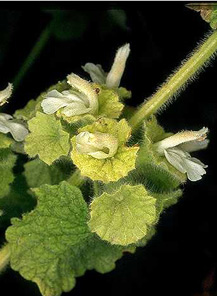
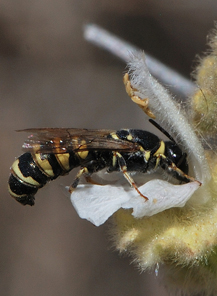
Ballota undulata (Lamiaceae) is probably the main host plant of Ochreriades fasciatus (Friese, 1899). Fotos O. Fragman, G. Pisanty.
Biogeography and diversity
The genus Ochreriades has a disjunct distribution with one species occurring in the Near East and a second species known from Namibia (Michener, 2007).
Phylogeny and classification
The phylogenetic position of Ochreriades within the megachilid bees is still unclear. A cladistic analysis of morphological characters suggested a sister group relationship with Chelostoma (Gonzalez et al., 2012), which, however, could not be confirmed by molecular data (Praz et al., 2008b; Litman et al., 2011). Depending on the molecular analysis, the position of Ochreriades varied within the Megachilinae as sister to all other Osmiini, as sister to Megachilini + Osmiini or as sister to Anthidiini + Megachilini + Osmiini (Praz et al., 2008b; Litman et al., 2011). In all cases, support for the phylogenetic position of Ochreriades was weak.
Nesting biology
Ochreriades fasciatus nests in beetle burrows in dead wood (Rozen et al., 2015). Cell partitions and nest plug are made of mud probably under addition of nectar. While the cell partitions exclusively consist of hardened mud, large pebbles are incorporated into the external surface of the nest plug.
Flower preferences
Ochreriades fasciatus is strictly oligolectic on Lamiaceae (Rozen et al., 2015). Among the Lamiaceae, Ballota undulata and Moluccella laevis are the preferred or even exclusive pollen hosts. In contrast to many bee species that regularly exploit Lamiaceae for pollen, the females of O. fasciatus lack specialized bristles on their face to remove pollen from the nototribic anthers of Lamiaceae (see Müller, 1996). Instead, pollen-collecting females of O. fasciatus climb the upper lip of Ballota undulata until the head is beyond the upper lip and pick up the pollen directly into the abdominal scopa by rapidly seesawing the underside of the abdomen against the anthers (Rozen et al., 2015). The same method of collecting pollen is known from Protosmia (Nanosmia) minutula at flowers of Teucrium montanum (Müller, 1996).
Species accounts
Ochreriades fasciatus (Friese, 1899)
1899 Eriades fasciatus Friese, Entomologische Nachrichten (Berlin), 25: 325. Type material: Holotype m, “Jericho” [Palestine], OUMNH (Oxford). Type species of Ochreriades Mavromoustakis.
Distribution-Southwestern Asia: IL, JOR, SYR.
Identification-Keys, Descriptions: Griswold (1994b); Mavromoustakis (1956b: 226-229).
Nesting biology-Nesting site: Preexisting cavities: beetle burrows (diameter 1.9-9mm) in dead trunks and branches of trees (e.g. Cupressus sempervirens) and shrubs (e.g. Rhamnus lycioides) with 1-5 linearly arranged brood cells. Nesting material: Cell partitions and nest plug are made of mud probably under addition of nectar. While the cell partitions exclusively consist of mud, large pebbles (diameter 1-2mm) are incorporated into the external surface of the nest plug. Compared to Chelostoma, these pebbles are much larger and the proportion of mud is distinctly lower. (Rozen et al., 2015)
Flower preferences: Oligolectic on Lamiaceae with a distinct or even exclusive preference for Ballota undulata and Moluccella laevis (Rozen et al., 2015).