Subgenus Hoplitis
The subgenus Hoplitis Klug is confined to the Palaearctic region. It contains 99 described species. The former subgenera Annosmia, Bytinskia and Coloplitis are included here in an enlarged subgenus Hoplitis due to i) polyphyly of Annosmia, ii) close relatedness of the cleptoparasitic Bytinskia species to their Annosmia hosts, iii) occurrence of taxa that are morphologically and biologically intermediate between Annosmia and Hoplitis, and iv) substantial morphological resemblance among the members of the whole clade (Sedivy et al., 2013c).
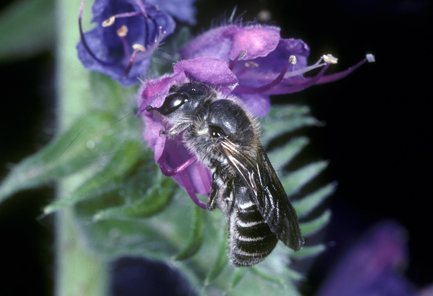
Female of Hoplitis (Hoplitis) adunca (Panzer, 1798) on a flower of Echium (Boraginaceae), the species’ exclusive pollen source. Foto A. Krebs.
Species accounts
bassana species group
Hoplitis (Hoplitis) bassana (Warncke, 1991)
1991 Osmia (Annosmia) bassana Warncke, Linzer Biologische Beiträge, 23: 313. Type material: Holotype f, “70 km O Tata” [Morocco], OLML (Linz); paratypes m(m), f(f).-Combination Hoplitis (Annosmia) bassana (Warncke) in Michener (2007) and Ungricht et al. (2008).
Distribution-Northern Africa: DZ, MA.
Identification-Keys, Descriptions: No supplementary or more detailed morphological description known.
Nesting biology: Unknown.
Flower preferences: Oligolectic on Trichodesma (Boraginaceae) (Sedivy et al., 2013a).
erythrogastra species group (“Bytinskia“)
Hoplitis (Hoplitis) erythrogastra (Mavromoustakis, 1954)
1954 Bytinskia erythrogastra Mavromoustakis, Bulletin of the Research Council of Israel, 4: 270. Type material: Holotype f, “Bat Yam” [Israel], DAAN (Nicosia); paratypes mm, ff. Type species of Bytinskia Mavromoustakis.-Combination Hoplitis (Bytinskia) erythrogastra (Mavromoustakis) in Michener (2007) and Ungricht et al. (2008).
Distribution-Northern Africa: MA, TN. Southwestern Asia: IL, JOR, RL.
Identification-Keys, Descriptions: Mavromoustakis (1949: 288, as Osmia sordida); Warncke (1991f).
Nesting biology: Cleptoparasitic in nests of Hoplitis (Annosmia) zonalis and possibly other species of the subgenus Annosmia. (Mavromoustakis, 1954b; Sedivy et al., 2013b)
Hoplitis (Hoplitis) negevensis (Warncke, 1991)
1991 Bytinskia negevensis Warncke, Linzer Biologische Beiträge, 23: 486. Type material: Holotype f, “Giv’ ot Loven/13 km S Paran in der Wüste Negev” [Israel], OLML (Linz).-Combination Hoplitis (Bytinskia) negevensis (Warncke) in Michener (2007) and Ungricht et al. (2008).
Distribution-Southwestern Asia:IL.
Identification-Keys, Descriptions: No supplementary or more detailed morphological description known.
Nesting biology: Cleptoparasitic in nests of Hoplitis (Annosmia) christae and possibly other species of the subgenus Annosmia. (Sedivy et al., 2013b; Warncke, 1991f)
Hoplitis (Hoplitis) parasitica (Warncke, 1991)
1991 Bytinskia parasitica Warncke, Linzer Biologische Beiträge, 23: 484. Type material: Holotype f, “Tal südlich des Gevria-Passes in 3000 m im Sat-Gebirge/Prov. Hakkari” [Turkey], OLML (Linz); paratypes mm, ff.-Combination Hoplitis (Bytinskia) parasitica (Warncke) in Michener (2007) and Ungricht et al. (2008).
Distribution-Europe: AZ. Southwestern Asia: IR, TR.
Identification-Keys, Descriptions: No supplementary or more detailed morphological description known.
Nesting biology: Cleptoparasitic in nests of Hoplitis (Annosmia) eremophila and probably other species of the subgenus Annosmia. (Warncke, 1991f)
persica species group (“Coloplitis“)
Hoplitis (Hoplitis) persica (Warncke, 1991)
1991 Osmia (Annosmia) persica Warncke, Linzer Biologische Beiträge, 23: 324. Type material: Holotype m, “Steppa pressa Chitgar/18 km W di Teheran” [Iran], OLML (Linz); paratypes mm, ff.-Combination Hoplitis (Coloplitis) persica (Warncke) in Michener (2007) and Ungricht et al. (2008).
Distribution-Southwestern Asia: IR.
Identification-Keys, Descriptions: Griswold and Michener (1998: 245-246).
Nesting biology: Unknown.
Flower preferences: Possibly oligolectic on Heliotropium (Boraginaceae) (Sedivy et al., 2013a). As in the Haetosmia species, which all collect pollen on Heliotropium, the females of H. persica have long, apically thickened and slightly curved bristles on their labial palpi (Warncke, 1991e). These bristles, which are amazingly similar to those of Haetosmia, are undoubtedly used to extract pollen from the narrow-tubed Heliotropium flowers.
Hoplitis (Hoplitis) premordica Griswold, 1998
1998 Hoplitis (Coloplitis) premordica Griswold, in: Griswold and Michener, Journal of the Kansas Entomological Society, 70: 244. Type material: Holotype m, “Baluchistan: Pishin, 40 km N Quetta” [Pakistan], AMNH (New York); paratypes mm, ff. Type species of Coloplitis Griswold.-Combination Hoplitis (Coloplitis) premordica Griswold in Michener (2007) and Ungricht et al. (2008).
Distribution-Southwestern Asia: PAK.
Identification-Keys, Descriptions: No supplementary or more detailed morphological description known.
Nesting biology: Unknown.
Flower preferences: Unknown. The females have long, apically thickened and curved bristles on their labial palpi (Griswold and Michener, 1998), which are probably used to extract pollen from narrow-tubed flowers.
annulata species group (“Annosmia“)
Hoplitis (Hoplitis) aqabaensis (Warncke, 1991)
1991 Osmia (Annosmia) aqabaensis Warncke, Linzer Biologische Beiträge, 23: 326. Type material: Holotype m, “80 km NO Aqaba (Strasse nach Amman)” [Jordan], OLML (Linz); paratypes mm, f. -Combination Hoplitis (Annosmia) aqabaensis (Warncke) in Michener (2007) and Ungricht et al. (2008).
Distribution-Northern Africa: TN. Southwestern Asia: JOR.
Identification-Keys, Descriptions: No supplementary or more detailed morphological description known.
Nesting biology: Unknown.
Flower preferences: Oligolectic on Echiochilon (Boraginaceae) (Sedivy et al., 2013a). The females of H. aqabaensis possess many long bristles on the underside of the first labial palpus and the first third of the second labial palpus, which are used to scrape pollen out of the trumpet-shaped flowers of Echiochilon fruticosum (Sedivy et al., 2013a).
Hoplitis (Hoplitis) annulata (Latreille, 1811)
1811 Osmia annulata Latreille, Encyclopédie Méthodique, Histoire Naturelle, Insectes, vol. 8, p. 587. Type material: m(m) [Spain], presumed lost (Warncke, 1991e: 311). Type species of Annosmia Warncke.-Combination Hoplitis (Hoplitis) annulata (Latreille) in Zanden (1988b: 121). Combination Osmia (Annosmia) annulata Latreille in Warncke (1991e: 311). Combination Hoplitis (Annosmia) annulata (Latreille) in Michener (2007) and Ungricht et al. (2008).
1887 Osmia pruinosa Destefani, Il Naturalista Siciliano, 6: 112. Type material: Syntypes m(m), f(f), “Villa Favorita presso Palermo” [Italy: Sicily].-Synonymy with Osmia crenulata Morawitz in Friese (1911b: 134). Synonymy with Osmia annulata Latreille in Warncke (1991e: 311).
Distribution-Europe: ARM, AZ, BG, E, F, GR, GR(Aegean Islands, Cr), HR, I, I(Sa)?, I(Si), P. Northern Africa: DZ, MA, TN. Southwestern Asia: CY, IL, IR, RL, SYR, TR.
Identification-Keys, Descriptions: Benoist (1931); Ducke (1900); Le Divelec et al. (2024: 155); Le Goff (2003a: 70); Mavromoustakis (1949: 292); Móczár (1958); Schmiedeknecht (1885-1886); Warncke (1991e).
Nesting biology-Nesting site: In excavated burrows in rather hard soil. The nests are 2-8cm deep and contain 1-4 cells at the end of the main burrow or of side burrows. Nesting material: Brood cell partitions and nest plug built from mud; the cells are excavated from the ground, their walls are smoothed and hardened on the inside but apparently not newly constructed. The nest burrow sometimes circumvents obstacles such as small stones. The nest entrance is hardened and little narrowed, often hidden near a plant base or under a stone. (Ferton, 1892; Le Goff, 2010; Mavromoustakis, 1957b)
Flower preferences: Oligolectic on Echium (Boraginaceae) (Sedivy et al., 2013a).
– subspecies annulata (Latreille, 1811)
1811 Automatically established nominotypical subspecific taxon (original description and type specimen are identical with those of the species rank taxon of the same name above).
Distribution-Europe: E, F, I(Sa)?, I(Si), P. Northern Africa: DZ, MA, TN.
Identification-Keys, Descriptions: Le Divelec et al. (2024: 155); Le Goff (2010).
– subspecies crenulata (Morawitz, 1871)
1871 Osmia crenulata Morawitz, Horae Societatis Entomologicae Rossicae (St. Petersburg), 8: 208 [not Heriades crenulatus Nylander, 1856]. Type material: Syntypes m(m), f(f), “Creta” [Greece: Crete], “Epirus, Corfu” [Greece], Corsica” [France: Corsica].-Combination Osmia (Ctenosmia) crenulata Morawitz in Schmiedeknecht (1885: 21 [887]). Combination Hoplitis (Hoplitis) crenulata (Morawitz) in Tkalcu (1975a: 179).
1991 Osmia (Annosmia) annulata cretica Warncke, Linzer Biologische Beiträge, 23: 312. NOMEN NOVUM with same type specimen for preoccupied Osmia crenulata Morawitz, 1871 [not Heriades crenulatus Nylander, 1856].
Distribution-Europe: ARM, AZ, BG, GR, GR(Aegean Islands, Cr), HR, I. Southwestern Asia: CY, IL, IR, RL, SYR, TR.
Identification-Keys, Descriptions: Le Divelec et al. (2024: 155);Le Goff (2010); Warncke (1991e); Zanden (1991c: 169-171).
Hoplitis (Hoplitis) cercomela (Warncke, 1991)
1991 Osmia (Annosmia) cercomela Warncke, Linzer Biologische Beiträge, 23: 314. Type material: Holotype f, “80 km NO Aqaba (Strasse nach Amman)” [Jordan], OLML (Linz); paratypes m, ff.-Combination Hoplitis (Annosmia) cercomela (Warncke) in Michener (2007) and Ungricht et al. (2008).
Distribution-Southwestern Asia: JOR.
Identification-Keys, Descriptions: No supplementary or more detailed morphological description known.
Nesting biology: Unknown.
Flower preferences: Unknown.
Hoplitis (Hoplitis) christae (Warncke, 1991)
1991 Osmia (Annosmia) christae Warncke, Linzer Biologische Beiträge, 23: 487. Type material: Holotype f, “Giv’ot Loven/13 km S Paran in der Negev-Wüste” [Israel], OLML (Linz); paratypes mm, ff.-Combination Hoplitis (Annosmia) christae (Warncke) in Michener (2007) and Ungricht et al. (2008).
Distribution- Northern Africa: MA. Southwestern Asia: IL.
Identification-Keys, Descriptions: No supplementary or more detailed morphological description known.
Nesting biology-Nesting site: In excavated burrows in the soil. Nesting material: Unknown. (Warncke, 1991f)
Flower preferences: Oligolectic on Blepharis attenuata (Acanthaceae) and possibly other Acanthaceae species (Sedivy et al., 2013a). Additional flower records: Fabaceae (Warncke, 1991f). The females possess a bunch of long and stiff bristles on the first two segments of their foretarsi, which are involved in a highly specialized pollen-collecting behaviour (Sedivy et al., 2013a): while firmly sitting on the lower lip of the Blepharis attenuata flowers with their middle and hind legs, pollen-collecting females push the four introrse anthers with their head apart and remove the pollen from between the anthers with their specialized foreleg pilosity.
Hoplitis (Hoplitis) chukar (Warncke, 1991)
1991 Osmia (Annosmia) chukar Warncke, Linzer Biologische Beiträge, 23: 316. Type material: Holotype m, “W Serpil in 1800 m/Mt. Cilo, Hakkari” [Turkey], OLML (Linz); paratypes mm, ff.-Combination Hoplitis (Annosmia) chukar (Warncke) in Michener (2007) and Ungricht et al. (2008).
Distribution-Southwestern Asia: TR.
Identification-Keys, Descriptions: No supplementary or more detailed morphological description known.
Nesting biology: Unknown.
Flower preferences: Unknown.
Hoplitis (Hoplitis) corsaria (Warncke, 1991)
1991 Osmia (Annosmia) annulata corsaria Warncke, Linzer Biologische Beiträge, 23: 311. Type material: Holotype m, “Ajaccio” [France: Corsica], OLML (Linz).-Elevated to species rank by Le Divelec et al. (2024: 153).
Distribution-Europe: F(Co).
Identification-Keys, Descriptions: Le Divelec et al. (2024: 155); Le Goff (2010).
Nesting biology-Nesting site: In excavated burrows in rather hard soil. The only nest found so far consisted of a 3 cm long burrow ending in a still open brood cell. Nesting material: Unknown, but most probably as in Hoplitis annulata. (Le Goff, 2010).
Flower preferences: Oligolectic on Echium (Boraginaceae) (Le Goff, 2010).
Hoplitis (Hoplitis) elaziga (Warncke, 1991)
1991 Osmia (Annosmia) elaziga Warncke, Linzer Biologische Beiträge, 23: 320. Type material: Holotype m, “Elazig, 1300 m” [Turkey], OLML (Linz); paratypes mm, ff.-Combination Hoplitis (Annosmia) elaziga (Warncke) in Michener (2007) and Ungricht et al. (2008).
Distribution-Southwestern Asia: TR.
Identification-Keys, Descriptions: No supplementary or more detailed morphological description known.
Nesting biology: Unknown.
Flower preferences: Unknown.
Hoplitis (Hoplitis) eremophila (Warncke, 1991)
1991 Osmia (Annosmia) eremophila Warncke, Linzer Biologische Beiträge, 23: 317. Type material: Holotype f, “nördlich Mt. Gavaruk in 2900 m/Sat-Geb., Hakkari” [Turkey], OLML (Linz); paratypes mm, ff.-Combination Hoplitis (Annosmia) eremophila (Warncke) in Michener (2007) and Ungricht et al. (2008).
Distribution-Southwestern Asia: SYR, TR.
Identification-Keys, Descriptions: No supplementary or more detailed morphological description known.
Nesting biology: Unknown.
Flower preferences: Unknown. The only pollen sample available so far consists of pollen of Fabaceae (A. Müller, unpublished).
Hoplitis (Hoplitis) fulica (Warncke, 1991)
1991 Osmia (Annosmia) fulica Warncke, Linzer Biologische Beiträge, 23: 312. Type material: Holotype m (see Blank and Kraus, 1994: 735), “Erçis/Van, 1650 m” [Turkey], OLML (Linz); paratypes mm, ff.-Combination Hoplitis (Annosmia) fulica (Warncke) in Michener (2007) and Ungricht et al. (2008).
Distribution-Southwestern Asia: TR.
Identification-Keys, Descriptions: No supplementary or more detailed morphological description known.
Nesting biology: Unknown.
Flower preferences: Unknown. The only pollen sample available so far consists of Fabaceae (A. Müller, unpublished).
Hoplitis (Hoplitis) gentilis (Warncke, 1991)
1991 Osmia (Annosmia) gentilis Warncke, Linzer Biologische Beiträge, 23: 320. Type material: Holotype m, “Sille bei Konya” [Turkey], OLML (Linz); paratype f.-Combination Hoplitis (Annosmia) gentilis (Warncke) in Michener (2007) and Ungricht et al. (2008).
Distribution-Southwestern Asia: TR.
Identification-Keys, Descriptions: No supplementary or more detailed morphological description known.
Nesting biology: Unknown.
Flower preferences: Unknown. The only pollen sample available so far consists of pollen of Astragalus (Fabaceae) (A. Müller, unpublished).
Hoplitis (Hoplitis) gusenleitneri (Warncke, 1991)
1991 Osmia (Annosmia) gusenleitneri Warncke, Linzer Biologische Beiträge, 23: 323. Type material: Holotype f, “Oukaimeden in 2600-2800 m” [Morocco], OLML (Linz).-Combination Hoplitis (Annosmia) gusenleitneri (Warncke) in Michener (2007) and Ungricht et al. (2008).
Distribution-Northern Africa: MA.
Identification-Keys, Descriptions: No supplementary or more detailed morphological description known. Note: Male unknown.
Nesting biology: Unknown.
Flower preferences: Unknown.
Hoplitis (Hoplitis) hierichonica (Mavromoustakis, 1949)
1949 Osmia hierichonica Mavromoustakis, Eos (Madrid), 25: 291. Type material: Holotype f, “Jericho” [Palestine], DAAN (Nicosia); paratype m.-Combination Anthocopa (Anthocopa) hierichonica (Mavromoustakis) in Zanden (1988b: 118). Combination Osmia (Annosmia) hierichonica (Mavromoustakis) in Warncke (1991e: 315). Combination Hoplitis (Annosmia) hierichonica (Mavromoustakis) in Michener (2007) and Ungricht et al. (2008).
Distribution-Northern Africa: MA, TN. Southwestern Asia: IL, JOR.
Identification-Keys, Descriptions: Mavromoustakis (1954b: 263); Warncke (1991e).
Nesting biology-Nesting site: In excavated burrows in rather hard soil. The single nest found so far was 2-3cm deep and contained 3 cells, of which two were linearly arranged at the end of the main burrow and one at the end of a short side burrow. Nesting material: Brood cell partitions built from mud; the cells are excavated from the ground, their walls are smoothed and hardened on the inside (Sedivy et al., 2013b)
Flower preferences: Oligolectic on Echium (Boraginaceae) (Sedivy et al., 2013a).
Male mating behaviour: A male was observed to scent-mark a plant stem (R. Prosi, personal communication).
– subspecies hierichonica (Mavromoustakis, 1949)
1949 Automatically established nominotypical subspecific taxon (original description and type specimen are identical with those of the species rank taxon of the same name above).
Distribution-Southwestern Asia: IL, JOR.
Identification-Keys, Descriptions: No supplementary or more detailed morphological description known.
– subspecies wolfi (Warncke, 1991)
1991 Osmia (Annosmia) hierichonica wolfi Warncke, Linzer Biologische Beiträge, 23: 316. Type material: Holotype m, “30 km W Quarzazate” [Morocco], OLML (Linz); paratypes mm, ff.
1991 Hoplitis (Hoplitis) lefeberi Zanden, Reichenbachia (Dresden), 28: 169. Type material: Holotype m, “Maroc-Tizn., S. Ifni, 100 m” [Morocco], RMNH (Leiden); paratypes mm, ff.-New synonymy based on comparison of type specimens (A. Müller, unpublished).
Distribution-Northern Africa: MA, TN.
Identification-Keys, Descriptions: No supplementary or more detailed morphological description known.
Hoplitis (Hoplitis) idaensis (Warncke, 1991)
1991 Osmia (Annosmia) idaensis Warncke, Linzer Biologische Beiträge, 23: 317. Type material: Holotype m, “Ida-Geb. in 2100 m” [Greece: Crete], OLML (Linz); paratypes m, f.-Combination Hoplitis (Annosmia) idaensisa (Warncke) in Michener (2007) and Ungricht et al. (2008).
Distribution-Europe: GR(Cr). Southwestern Asia: TR.
Identification-Keys, Descriptions: No supplementary or more detailed morphological description known.
Nesting biology: Unknown.
Flower preferences: Unknown. 2 pollen samples from the same locality contained pollen of Fabaceae (A. Müller, unpublished).
Hoplitis (Hoplitis) israelica (Warncke, 1991)
1991 Osmia (Annosmia) annulata israelica Warncke, Linzer Biologische Beiträge, 23: 312. Type material: Holotype m, “Naharia” [Israel], OLML (Linz); paratypes mm, f.-Combination Hoplitis (Annosmia) israelica (Warncke) in Zanden (1996b: 885).-Combination Hoplitis (Annosmia) israelica (Warncke) in Michener (2007) and Ungricht et al. (2008).
Distribution-Northern Africa: MA, TN. Southwestern Asia: IL, IR, JOR.
Identification-Keys, Descriptions: No supplementary or more detailed morphological description known.
Nesting biology: Unknown.
Flower preferences: Oligolectic on Echium (Boraginaceae) (Sedivy et al., 2013a).
Hoplitis (Hoplitis) kaszabi Tkalcu, 2000
2000 Hoplitis (Annosmia) kaszabi Tkalcu, Acta Societatis Zoologicae Bohemoslovacae (Praha), 64: 318. Type material: Holotype m, “Central Aimak Ulan-Baator, Nucht im Bagdo ul, 1880 m” [Mongolia]; HNHM (Budapest); paratypes m, ff.
Distribution-Northern Asia: KZ, MGL, RC(NO), RUS(WS,ES), TJ.
Identification-Keys, Descriptions: No supplementary or more detailed morphological description known.
Nesting biology: Unknown.
Flower preferences: Unknown.
Hoplitis (Hoplitis) leiocephala (Mavromoustakis, 1954)
1954 Osmia leiocephala Mavromoustakis, Bulletin of the Research Council of Israel, 4: 263. Type material: Holotype f, “15 km south of Kurnub” [Israel], DAAN (Nicosia); paratypes mm, ff.-Combination Anthocopa (Anthocopa) leiocephala (Mavromoustakis) in Zanden (1988b: 118). Combination Osmia (Annosmia) leiocephala Mavromoustakis in Warncke (1991e: 329). Combination Hoplitis (Annosmia) leiocephala (Mavromoustakis) in Michener (2007) and Ungricht et al. (2008).
Distribution-Southwestern Asia: IL.
Identification-Keys, Descriptions: Warncke (1991e).
Nesting biology: Unknown.
Flower preferences: Probably oligolectic on Antirrhineae (A. Müller, unpublished, based on 8 pollen samples from 5 different localities). Flower record: Kickxia floribunda (C. Praz and C. Sedivy, personal observation; label record).
Hoplitis (Hoplitis) monticola Müller, 2012
2012 Hoplitis (Annosmia) monticola Müller, Zootaxa, 3355: 39. Type material: Holotype m, “Erymanthos mountains, Michas, 1600-2220m” [Greece], ETHZ (Zurich); paratypes mm, ff.
Distribution-Europe: GR. Southwestern Asia: TR.
Identification-Keys, Descriptions: No supplementary or more detailed morphological description known.
Nesting biology: Unknown.
Flower preferences: Unknown; the only pollen sample analyzed so far contained pollen of Fabaceae (probably Astragalus) (Müller, 2012a).
Hoplitis (Hoplitis) mutica (Warncke, 1991)
1991 Osmia (Annosmia) mutica Warncke, Linzer Biologische Beiträge, 23: 319. Type material: Holotype m, “Madensehir in 1300 m/Konya” [Turkey], OLML (Linz); paratypes mm, ff.-Combination Hoplitis (Annosmia) mutica (Warncke) in Michener (2007) and Ungricht et al. (2008).
Distribution-Europe: AZ. Southwestern Asia: IR, SYR, TR.
Identification-Keys, Descriptions: No supplementary or more detailed morphological description known.
Nesting biology: Unknown.
Flower preferences: Oligolectic on Fabaceae with a strong preference for Astragalus (Sedivy et al., 2013a).
Hoplitis (Hoplitis) nisa (Warncke, 1991)
1991 Osmia (Annosmia) nisa Warncke, Linzer Biologische Beiträge, 23: 329. Type material: Holotype f, “10 km SW Akka” [Morocco], OLML (Linz); paratypes mm, ff.-Combination Hoplitis (Annosmia) nisa (Warncke) in Michener (2007) and Ungricht et al. (2008).
1991 Hoplitis (Hoplitis) speculumoides Zanden, Linzer Biologische Beiträge, 23: 350. Type material: Holotype m, “Erfoud, Tafilalet” [Morocco], RMNH (Leiden); paratypes mm, ff.-Synonymy in Warncke (1991g: 568).
Distribution-Northern Africa: DZ, MA, TN.
Identification-Keys, Descriptions: No supplementary or more detailed morphological description known.
Nesting biology: Unknown.
Flower preferences: Oligolectic on Antirrhineae (e.g., Antirrhinum, Kickxia, Linaria) (Sedivy et al., 2013a). The median area of the female clypeus is bare and conspicuously bent. This peculiar clypeal form, which is confined to the female sex and also occurs in the females of H. speculum, an oligolege of Antirrhineae as well, is used to gain access to the hidden anthers of the occluded Antirrhineae flowers by pushing the specialized facial area against the upper lip, thereby opening the flowers (Sedivy et al., 2013a).
Hoplitis (Hoplitis) ochruros (Warncke, 1991)
1991 Osmia (Annosmia) ochruros Warncke, Linzer Biologische Beiträge, 23: 322. Type material: Holotype f, “20 km SO Erfoud” [Morocco], OLML (Linz); paratypes m(m), f(f).-Combination Hoplitis (Annosmia) ochruros (Warncke) in Michener (2007) and Ungricht et al. (2008).
Distribution-Northern Africa: DZ, MA, TN.
Identification-Keys, Descriptions: No supplementary or more detailed morphological description known.
Nesting biology: Unknown.
Flower preferences: Mesolectic on Antirrhineae (e.g. Kickxia) and Fabaceae (A. Müller, unpublished, based on 43 pollen samples from 13 different localities and on field observations).
– subspecies crecca (Warncke, 1991)
1991 Osmia (Annosmia) ochruros crecca Warncke, Linzer Biologische Beiträge, 23: 323. Type material: Holotype f, “20 km N Sfax” [Tunisia], OLML (Linz).
Distribution-Northern Africa: TN.
Identification-Keys, Descriptions: No supplementary or more detailed morphological description known.
– subspecies ochruros (Warncke, 1991)
1991 Automatically established nominotypical subspecific taxon (original description and type specimen are identical with those of the species rank taxon of the same name above).
Distribution-Northern Africa: DZ, MA.
Identification-Keys, Descriptions: No supplementary or more detailed morphological description known.
Hoplitis (Hoplitis) parana (Warncke, 1991)
1991 Osmia (Annosmia) parana Warncke, Linzer Biologische Beiträge, 23: 328. Type material: Holotype f, “Giv ot Loven/13 km S Paran” [Israel], OLML (Linz); paratypes m(m), f(f).-Combination Hoplitis (Annosmia) parana (Warncke) in Michener (2007) and Ungricht et al. (2008).
Distribution-Southwestern Asia: IL, OM, UAE.
Identification-Keys, Descriptions: No supplementary or more detailed morphological description known.
Nesting biology: Unknown.
Flower preferences: Oligolectic on Fabaceae with a strong preference for Crotalaria (Sedivy et al., 2013a).
Hoplitis (Hoplitis) peralba Zanden, 1992
1992 Hoplitis (Annosmia) peralba Zanden, Linzer Biologische Beiträge, 24: 67. Type material: Holotype m, “Deesa” [India], RMNH (Leiden); paratype m.
Distribution-Northern Africa: ET. Extralimital: Oriental (India).
Identification-Keys, Descriptions: No supplementary or more detailed morphological description known. Note: Female unknown.
Nesting biology: Unknown.
Flower preferences: Unknown.
Hoplitis (Hoplitis) samarkanda (Warncke, 1991)
1991 Osmia (Annosmia) samarkanda Warncke, Linzer Biologische Beiträge, 23: 318. Type material: Holotype m, “Aman Kutan/35 km N Samarkand” [Uzbekistan], OLML (Linz); paratype m.-Combination Hoplitis (Annosmia) samarkanda (Warncke) in Michener (2007) and Ungricht et al. (2008).
Distribution-Northern Asia: TJ, UZ.
Identification-Keys, Descriptions: No supplementary or more detailed morphological description known. Note: Female unknown.
Nesting biology: Unknown.
Flower preferences: Unknown.
Hoplitis (Hoplitis) segura (Warncke, 1991)
1991 Osmia (Annosmia) segura Warncke, Linzer Biologische Beiträge, 23: 327. Type material: Holotype f, “Wadi Segur/40 km NW Eilat” [Israel], OLML (Linz); paratypes mm, ff.-Combination Hoplitis (Annosmia) segura (Warncke) in Michener (2007) and Ungricht et al. (2008).
Distribution-Southwestern Asia: IL.
Identification-Keys, Descriptions: No supplementary or more detailed morphological description known.
Nesting biology: Unknown.
Flower preferences: Mesolectic on Echium (Boraginaceae), Fabaceae and Antirrhineae (Sedivy et al., 2013a).
Hoplitis (Hoplitis) sordida (Benoist, 1929)
1929 Osmia sordida Benoist, Bulletin de la Société Entomologique de France, 1929: 99. Type material: Holotype m, “Syrie: Jaffa” [Israel], MNHN (Paris).-Combination Anthocopa (Anthocopa) sordida (Benoist) in Zanden (1985: 60). Combination Osmia (Annosmia) sordida Benoist in Warncke (1991e: 322). Combination Hoplitis (Annosmia) sordida (Benoist) in Michener (2007) and Ungricht et al. (2008).
Distribution-Northern Africa: ET. Southwestern Asia: IL.
Identification-Keys, Descriptions: Warncke (1991e); Zanden (1985: 60).
Nesting biology: Unknown.
Flower preferences: Unknown.
Hoplitis (Hoplitis) speculum (Benoist, 1934)
1934 Osmia speculum Benoist, Bulletin de la Société Entomologique de France, 39: 106. Type material: Holotype f, “Ghardaia” [Algeria], MNHN (Paris).-Combination Hoplitis (Hoplitis) speculum (Benoist) in Zanden (1985: 62). Combination Osmia (Annosmia) speculum Benoist in Warncke (1991e: 328). Combination Hoplitis (Annosmia) speculum (Benoist) in Michener (2007) and Ungricht et al. (2008).
1934 Osmia pseudo-speculum Benoist, Bulletin de la Société Entomologique de France, 39: 107. Type material: Holotype f, “entre Mogador et Agadir” [Morocco], MNHN (Paris).-Synonymy in Zanden (1985: 65).
Distribution-Northern Africa: DZ, MA.
Identification-Keys, Descriptions: Mavromoustakis (1949: 293, 1954b: 265); Warncke (1991e); Zanden (1985: 62, 65, 1991b: 350-351).
Nesting biology-Nesting site: In excavated burrow in rather hard soil. Nesting material: Unknown. (Sedivy et al., 2013b)
Flower preferences: Oligolectic on Antirrhineae (e.g., Antirrhinum, Kickxia, Linaria) (Sedivy et al., 2013a). The median area of the female clypeus of H. speculum is bare and conspicuously bent. As in Hoplitis nisa, this specialized facial area is probably used to open the occluded Antirrhineae flowers (Sedivy et al., 2013a).
Hoplitis (Hoplitis) tkalcuella Le Goff, 2003
2003 Hoplitis (Annosmia) tkalcuella Le Goff, Bulletin de la Société Entomologique de France, 108: 67. Type material: Holotype m, “Guardamar del Segura (Alicante)” [Spain], Le Goff Collection (Barentin); paratypes mm, ff.
Distribution-Europe: E, P.
Identification-Keys, Descriptions: No supplementary or more detailed morphological description known.
Nesting biology-Nesting site: In excavated burrows in rather hard soil. The entrance burrow ramifies after a length of ca. 1cm into four branches, each containing 1-3 linearly arranged cells separated from each other by a layer of mud. Nesting material: Cell partitions and nest plug built from mud. (Le Goff, 2003c, 2010)
Flower preferences: Oligolectic on Echium (Boraginaceae) (Le Goff, 2003c; A. Müller, unpublished, based on 7 pollen samples from the same locality).
Hoplitis (Hoplitis) tunica (Warncke, 1991)
1991 Osmia (Annosmia) tunica Warncke, Linzer Biologische Beiträge, 23: 323. Type material: Holotype m, “Nefta” [Tunisia], OLML (Linz); paratype m.-Combination Hoplitis (Annosmia) tunica (Warncke) in Michener (2007) and Ungricht et al. (2008).
Distribution-Northern Africa: TN. Southwestern Asia: IL.
Identification-Keys, Descriptions: No supplementary or more detailed morphological description known.
Nesting biology: Unknown.
Flower preferences: Females were observed to exclusively visit the flowers of Moltkiopsis ciliata (Boraginaceae) both in Israel and Tunisia (C. Praz, C. Sedivy and A. Müller, unpublished), suggesting that H. tunica is a Moltkiopsis oligolege. This assumption is supported by the observation that the males of H. tunica patrolled Moltkiopsis flowers in search of females as well as by the only pollen sample available so far, which consists of Moltkiopsis pollen (A. Müller, unpublished).
Hoplitis (Hoplitis) uncaticornis (Stanek, 1969)
1969 Osmia uncaticornis Stanek, Nachrichten des Naturwissenschaftlichen Museums der Stadt Aschaffenburg, 78: 11. Type material: Holotype m, “Mut” [Turkey], SMFD (Frankfurt).-Combination Anthocopa (Anthocopa) uncaticornis (Stanek) in Zanden (1980: 230). Combination Osmia (Annosmia) uncaticornis Stanek in Warncke (1991e: 321). Combination Hoplitis (Annosmia) uncaticornis (Stanek) in Michener (2007) and Ungricht et al. (2008).
Distribution- Europe: GR. Southwestern Asia: IR, SYR, TR.
Identification-Keys, Descriptions: Warncke (1991e); Zanden (1980: 230).
Nesting biology: Unknown.
Flower preferences: Oligolectic on Fabaceae with a strong or even exclusive preference for Astragalus (Sedivy et al., 2013a).
– subspecies cursoria (Warncke, 1991)
1991 Osmia (Annosmia) uncaticornis cursoria Warncke, Linzer Biologische Beiträge, 23: 321. Type material: Holotype m, “20 km SO Harran in 500 m/Urfa” [Turkey], OLML (Linz); paratypes mm, ff.
Distribution-Southwestern Asia:SYR, TR.
Identification-Keys, Descriptions: No supplementary or more detailed morphological description known.
– subspecies uncaticornis (Stanek, 1969)
1969 Automatically established nominotypical subspecific taxon (original description and type specimen are identical with those of the species rank taxon of the same name above).
Distribution- Europe: GR. Southwestern Asia: TR.
Identification-Keys, Descriptions: No supplementary or more detailed morphological description known.
Hoplitis (Hoplitis) verhoeffi (Mavromoustakis, 1954)
1954 Osmia verhoeffi Mavromoustakis, Bulletin of the Research Council of Israel, 4: 265. Type material: Holotype f, “Bat Yam” [Israel], DAAN (Nicosia); paratypes mm, ff.-Combination Osmia (Annosmia) verhoeffi Mavromoustakis in Warncke (1991e: 321). Combination Hoplitis (Annosmia) verhoeffi (Mavromoustakis) in Michener (2007) and Ungricht et al. (2008).
Distribution-Southwestern Asia: IL, JOR.
Identification-Keys, Descriptions: Warncke (1991e).
Nesting biology: Unknown.
Flower preferences: Unknown. The two pollen samples available so far (from two different localities) consist of pollen of Fabaceae (A. Müller, unpublished).
Hoplitis (Hoplitis) zonalis (Pérez, 1895)
1895 Osmia zonalis Pérez, Espèces nouvelles de mellifères de Barbarie, p. 14. Type material: f(f) [Algeria], MNHN (Paris).-Combination Osmia (Osmia) zonalis Pérez in Friese (1911b: 97). Combination Hoplitis (Hoplitis) zonalis (Pérez) in Zanden (1988b: 122). Combination Osmia (Annosmia) zonalis Pérez in Warncke (1991e: 325). Combination Hoplitis (Annosmia) zonalis (Pérez) in Michener (2007) and Ungricht et al. (2008).
1902 Osmia undulata Pérez, Procès-verbaux de la Société Linnéenne de Bordeaux, 57: 66. Type material: m(m), “Foum-Tatahouin” [Tunisia], MNHN (Paris).-Combination Hoplitis (Hoplitis) undulata (Pérez) in Zanden (1988b: 122).-Synonymy in Warncke (1991e: 325).
1929 Osmia taprurensis Benoist, Bulletin de la Société Entomologique de France, 1929: 98. Type material: Lectotype m, by designation of Zanden (1985: 57), “Sfax” [Tunisia], MNHN (Paris); paralectotypes mm.-Combination Hoplitis (Hoplitis) taprurensis (Benoist) in Zanden (1985: 58).-Synonymy in Warncke (1991e: 325).
Distribution-Northern Africa: DZ, MA, TN. Southwestern Asia: IL.
Identification-Keys, Descriptions: Mavromoustakis (1949: 292-293, 1954b: 262-263, as Osmia sordida); Warncke (1991e); Zanden (1985: 58-59).
Nesting biology-Nesting site: In excavated burrows in hard-packed sandy soil; the nests are 4-5cm deep containing 1-2 cells at the end of the main burrow or of very short lateral burrows. Nesting material: Brood cell partitions built from mud; the cells are excavated from the ground, their walls are smoothed and hardened on the inside but apparently not newly constructed.(Mavromoustakis, 1954b; Sedivy et al., 2013b)
Flower preferences: Oligolectic on Echium (Boraginaceae) (Mavromoustakis, 1954b; Sedivy et al., 2013a).
– subspecies bodenheimeri (Mavromoustakis, 1949)
1949 Osmia bodenheimeri Mavromoustakis, Eos (Madrid), 25: 289. Type material: Holotype f, “Pardes Hannah” [Israel], DAAN (Nicosia); paratype m.-Synonymy with Osmia sordida Benoist in Mavromoustakis (1954b: 262), rejected by Warncke (1991e: 326).-Combination Osmia (Annosmia) zonalis bodenheimeri Mavromoustakis in Warncke (1991e: 325).
Distribution-Southwestern Asia: IL.
Identification-Keys, Descriptions: Warncke (1991e).
– subspecies zonalis (Pérez, 1895)
1895 Automatically established nominotypical subspecific taxon (original description and type specimen are identical with those of the species rank taxon of the same name above).
Distribution-Northern Africa: DZ, MA, TN.
Identification-Keys, Descriptions: No supplementary or more detailed morphological description known.
monstrabilis species group
Hoplitis (Hoplitis) astragali Fateryga, Müller & Proshchalykin, 2023
2023 Hoplitis (Hoplitis) astragali Fateryga, Müller & Proshchalykin, Journal of Hymenoptera Research, 96: 644. Type material: Holotype m, “Dagestan, Tsudakhar” [Russia], Zoological Institute of the Russian Academy of Sciences St. Petersburg; paratypes mm, ff.
Distribution-Europe: AZ, RUS(SR). Northern Asia: TM.
Identification-Keys, Descriptions: No supplementary or more detailed morphological description known.
Nesting biology-Nesting site: Excavated burrows in vertical clay cliffs containing 1-3 brood cells arranged in a linear series. Nesting material: The cell partitions and the nest plug are made of mud. The inner surface of the cell is covered with a 0.4mm thick wall composed of compact soil,most probably built by the female bee after cell excavation. The space in front of the outermost brood cell is not filled with soil resulting in an empty vestibule of 5-14mm in length. Life cycle: The species overwinters as prepupa in the brood cells; some individuals pass a second winter in the cells. Brood parasites: Sapyga caucasica (Hymenoptera, Sapygidae). (Fateryga et al., 2023)
Flower preferences: Probably oligolectic on Fabaceae with a strong or even exclusive preference for Astragalus (Fateryga et al., 2023).
Hoplitis (Hoplitis) erzurumensis Tkalcu, 2000
2000 Hoplitis (Hoplitis) erzurumensis Tkalcu, Acta Societatis Zoologicae Bohemoslovacae (Praha), 64: 323. Type material: Holotype m, “Erzurum” [Turkey]; Tkalcu Collection (Praha); paratypes mm, ff.
Distribution-Southwestern Asia: TR.
Identification-Keys, Descriptions: No supplementary or more detailed morphological description known.
Nesting biology: Unknown.
Flower preferences: Probably oligolectic on Fabaceae (e.g. Onobrychis, Medicago, Trifolium) (Özbek, 1979b; A. Müller, unpublished, based on 14 pollen samples from 7 different localities).
Hoplitis (Hoplitis) hyperplastica (Morawitz, 1894)
1894 Osmia hyperplastica Morawitz, Horae Societatis Entomologicae Rossicae (St. Petersburg), 28: 34. Type material: m(m), “Turusch-Dara” [Turkestan].-Combination Osmia (Osmia) hyperplastica Morawitz in Friese (1911b: 83). Combination Osmia (Alcidamea) hyperplastica Morawitz in Warncke (1991h: 720).
Distribution-Northern Asia: KS, TJ; Turkestan.
Identification-Keys, Descriptions: Ducke (1900). Note: Female unknown.
Nesting biology: Unknown.
Flower preferences: Unknown.
Hoplitis (Hoplitis) lapidaria (Morawitz, 1877)
1877 Osmia lapidaria Morawitz, Horae Societatis Entomologicae Rossicae (St. Petersburg), 14: 40. Type material: Lectotype f, by designation of Warncke (1991e: 315), “Eriwan” [Armenia], ZIN (St. Petersburg); paralectotypes ff.-Combination Osmia (Ctenosmia) lapidaria Morawitz in Schmiedeknecht (1885: 21 [887]). Combination Osmia (Annosmia) lapidaria Morawitz in Warncke (1991e: 315).
Distribution-Europe: ARM. Southwestern Asia: TR.
Identification-Keys, Descriptions: Tkalcu (2000a: 329); Schmiedeknecht (1885-1886); Warncke (1991e). Note: Male unknown.
Nesting biology-Nesting site: Possibly in fissures of rocks. Nesting material: Unknown. (Morawitz, 1877)
Flower preferences: The only 2 pollen samples available so far (from 2 different localities) consist of pollen of Hedysareae (Fabaceae) (A. Müller, unpublished).
Hoplitis (Hoplitis) monstrabilis Tkalcu, 2000
2000 Hoplitis (Hoplitis) monstrabilis Tkalcu, Acta Societatis Zoologicae Bohemoslovacae (Praha), 64: 323. Type material: Holotype m, “Erzurum” [Turkey], EMET (Erzurum); paratypes ff.
Distribution-Southwestern Asia: JOR, TR.
Identification-Keys, Descriptions: No supplementary or more detailed morphological description known.
Nesting biology-Nesting site: Excavated burrows in sparsely vegetated to bare, horizontal and hard soil with 5-8 cells attached to the main tunnel or to one another in a linear series (similar to Hoplitis mocsaryi). The nests are very shallow, some cells are only 2-2.5cm below the ground surface. Nesting material: The cell partitions are made of mud. Each cell exhibits a 1-2mm thick cell wall composed of compact soil; the nature of the cell wall is unclear: it is either a special clay coating transported into the cell and applied by the female, or it is merely the result of the female smoothing the inner surface of the newly excavated cell. (Rozen et al., 2009).
Flower preferences: Oligolectic on Hedysareae (Fabaceae) (Rozen et al., 2009; Sedivy et al., 2013a).
Hoplitis (Hoplitis) tenuiserrata (Benoist, 1950)
1950 Osmia tenuiserrata Benoist, Bulletin de la Société des Sciences Naturelles du Maroc (Rabat), 30: 45. Type material: Holotype m, “Goulimine” [Morocco], MNHN (Paris).-Combination Osmia (Hoplitis) tenuiserrata Benoist in Warncke (1992a: 111).
1950 Osmia gibbifera Benoist, Bulletin de la Société des Sciences Naturelles du Maroc (Rabat), 30: 46. Type material: Holotype f, “Goulimine” [Morocco], MNHN (Paris).-Synonymy in Zanden (1985: 68).
Distribution-Northern Africa: MA.
Identification-Keys, Descriptions: Warncke (1992a); Zanden (1985: 67-68).
Nesting biology-Nesting site: Excavated burrows in sparsely vegetated horizontal soil. The only nest found so far consisted of a 8mm long vertical burrow containing one still open brood cell at its end measuring 7.5mm in length. Nesting material: The cell had a thin wall composed of compact soil, which was either applied by the female or resulted from the smoothing of the inner surface of the newly excavated cell. (Le Goff, 2017b, personal communication)
Flower preferences: Oligolectic on Fabaceae with a strong or even exclusive preference for Loteae (Sedivy et al., 2013a).
adunca species group
Hoplitis (Hoplitis) adunca (Panzer, 1798)
1798 Apis adunca Panzer, Faunae Insectorum Germanicae, 56: 5. Type material: m(m), [Germany]. Type species of Ctenosmia Thomson and Hoplitis Klug.-Combination Osmia (Ctenosmia) adunca (Panzer) in Schmiedeknecht (1885: 21 [887]). Combination Osmia (Hoplitis) adunca (Panzer) in Warncke (1992a: 116).
1841 Osmia Spinolae Lepeletier, Histoire Naturelle des Insectes, Hyménoptères, vol. 2, p. 328 [not seen]. Type material: Lectotype f, by designation of Tkalcu (1975a: 176), “toute la France” [France], MNHN (Paris).-Synonymy in Tkalcu (1975a: 176).
1910 Osmia aduncoides Strand, Entomologische Zeitschrift (Frankfurt), 24: 216. Type material: Lectotype m, by designation of T. Griswold (Zanden, 1989: 73), “Algier, Constantine” [Algeria], ZMHB (Berlin).-Synonymy with Hoplitis adunca contraria Tkalcu in Zanden (1989: 73).
1974 Hoplitis (Hoplitis) adunca contraria Tkalcu, Beiträge zur Entomologie (Berlin), 24: 329. Type material: Holotype f, “Villabáñez Valladolid” [Spain], Asensio Collection (Valladolid); paratypes mm, ff.-Synonymy in Warncke (1992a: 116).
Distribution-Europe: A, AL, AND, ARM, AZ, B, BG, BIH, BY, CH, CZ, D, DK, E, E(Ba), EST, F, F(Co), FL, GB, GE, GR (mainland, Aegean Islands), H, HR, I, I(Sa), I(Si), L, LT, LV, M, NL, P, PL, RO, RUS(CR,SR), SK, SCG, SLO, UA. Northern Africa: DZ, LAR, MA, TN. Northern Asia: KS, KZ, RUS(FS), TM. Southwestern Asia: TR.
Identification-Keys, Descriptions: Amiet et al. (2004); Banaszak and Romasenko (2001); Benoist (1931); Ducke (1900); Medvedeva (1978); Móczár (1958); Morice (1901); Müller (2016); Radoszkowski (1887a: 287-288); Romankova (1995); Scheuchl (1996); Schmiedeknecht (1885-1886); Warncke (1992a); Zanden (1983: 131); Le Divelec (2024).
Nesting biology-Nesting site: Preexisting cavities: insect burrows and drilled borings in dead wood; hollow stems (e.g. Phragmites) and drilled borings in stems; abandoned cells and burrows of other aculeates (e.g. Megachile parietina, Colletes, Anthophora, Odynerus); holes and crevices in clay and stone walls and in banks; glass tubes. Nesting material: Cell partitions and nest plug made of mud without addition of pebbles. The outer surface of the nest plug is often covered with wood fibers, sand, dust etc. There is a clear tendency to line the burrow walls completely or partially with mud; in the most extreme case, the nest consists of a uniform mud cylinder containig several cells. The cells are delimited both in front and in the rear by two mud partitions glued together, which might indicate remains of the habit to build entire cells. (Banaszak and Romasenko, 2001; Benoist, 1931; Bosch, Vicens and Blas, 1993; Brechtel, 1986; Friese, 1923; Grandi, 1961; Le Goff, 2004b; Malyshev, 1937; Müller et al., 1997; Popovici-Baznosanu, 1909; Westrich, 1989)
Flower preferences: Oligolectic on Echium (Boraginaceae) (Amiet et al., 2004; Banaszak and Romasenko, 2001; Gogala, 1999; Sedivy et al., 2013a; Westrich, 1989).
Hoplitis (Hoplitis) albopilosa Wu, 1987
1987 Hoplitis (Hoplitis) albopilosa Wu, Acta Entomologica Sinica (Beijing), 30: 445, 449. Type material: Holotype f, “Xizang, Gongbujiangda” [China], IZCAS (Beijing).
Distribution-Northern Asia: RC(WP).
Identification-Keys, Descriptions: Wu (2006). Note: Male unknown.
Nesting biology: Unknown.
Flower preferences: Unknown.
Hoplitis (Hoplitis) andreasmuelleri Fateryga & Proshchalykin, 2024
2024 Hoplitis (Hoplitis) andreasmuelleri Fateryga & Proshchalykin, Journal of Hymenoptera Research, 97: 1422. Type material: Holotype m, “Dagestan: vicinity of Kurush” [Russia], ZISP (St. Petersburg); paratypes mm, ff
Distribution-Europe: RUS(SR).
Identification-Keys, Descriptions: No supplementary or more detailed morphological description known.
Nesting biology: Unknown.
Flower preferences: Possibly oligolectic on Vicia (Fabaceae) (Fateryga et al., 2024).
Hoplitis (Hoplitis) anthocopoides (Schenck, 1853)
1853 Osmia anthocopoides Schenck, Jahrbücher des Vereins für Naturkunde im Herzogthum Nassau, 9: 181. Type material: Lectotype f, by designation of Tkalcu (1975a: 177), “Herzogthum Nassau” [Germany], SMFD (Frankfurt); paralectotype m.-Combination Osmia (Hoplitis) anthocopoides Schenck in Warncke (1992a: 113).
1869 Osmia caementaria Gerstaecker, Entomologische Zeitung (Stettin), 30: 339. Type material: Lectotype m, by designation of Tkalcu (1975a: 177), “Mark Brandenburg Falkenberg” [Germany], ZMHB (Berlin); paralectotype f.-Combination Osmia (Ctenosmia) caementaria Gerstaecker in Schmiedeknecht (1885: 21 [887]).-Synonymy in Tkalcu (1975a: 177).
1879 Osmia hybrida Pérez, Actes de la Société Linnéenne de Bordeaux, 33: 200. Type material: Syntypes m(m), f(f), “Marseille” [France], MNHN (Paris).-Combination Osmia (Ctenosmia) hybrida Pérez in Schmiedeknecht (1885: 21 [887]).-Synonymy in Warncke (1992a: 113).
1901 Osmia romana Morice, Transactions of the Entomological Society of London, 1901: 176. Type material: Holotype m, “Roma” [Italy], OUMNH (Oxford).-Synonymy in Tkalcu (1977b: 228).
1969 Fertonella algerica Benoist, Bulletin de la Société Entomologique de France, 74: 244. Type material: Holotype f, “Dellys” [Algeria], MNHN (Paris).-Synonymy in Warncke (1992a: 113).
Distribution-Europe: A, ARM, B, BG, BY, CH, CZ, D, DK, E, E(Ba), EST, F, F(Co), H, HR, I, I(Si), L, LT, LV, MK, NL, P, PL, RO, RUS(SR), S, SCG, SK, SLO, UA, UA(Crimea). Northern Africa: DZ, MA, TN. Extralimital: Nearctic (Canada, USA) [Introduced].
Identification-Keys, Descriptions: Amiet et al. (2004); Banaszak and Romasenko (2001); Benoist (1931, as Osmia spinolae); Ducke (1900, as Osmia spinolae); Eickwort (1970: 190, 192); Medvedeva (1978); Móczár (1958); Morice (1901); Müller (2016); Scheuchl (1996); Schmiedeknecht (1885-1886); Warncke (1992a).
Nesting biology-Nesting site: In depressions, cracks or surface irregularities of stones, rocks or walls where the brood cells are more or less exposed; in small rock cavities containing 1-3 hidden cells. Nests contain 1-33, mostly 3-8 cells. Nesting material: Brood cells and nest plug built from rather coarse pebbles cemented together with mud. Exposed cells finally covered by a continuous layer of mud and small pebbles. (Banaszak & Romasenko, 2001; Benoist, 1931; Bonelli, 1971; Eickwort, 1973, 1975; Friese, 1923; Gerstaecker, 1869; Le Goff 2004b; Müller et al., 1997; Westrich, 1989)
Flower preferences: Oligolectic on Echium (Boraginaceae) (Amiet et al., 2004; Banaszak and Romasenko, 2001; Eickwort, 1973, 1975; Gogala, 1999; Sedivy et al., 2013a; Westrich, 1989).
Hoplitis (Hoplitis) benoisti (Alfken, 1935)
1879 Osmia Morawitzi Pérez, Actes de la Société Linnéenne de Bordeaux, 33: 199. NOMEN PRAEOCCUPATUM [not Osmia morawitzi Gerstaecker, 1869]. Type material: Syntypes m(m), f(f), “Marseille, Montpellier” [France], MNHN (Paris).-Combination Osmia (Ctenosmia) morawitzi Pérez in Schmiedeknecht (1885: 21 [887]).
1935 Osmia benoisti Alfken, Veröffentlichungen aus dem Deutschen Kolonial- und Übersee-Museum in Bremen, 1: 189. NOMEN NOVUM with same type specimen for preoccupied Osmia morawitzi Pérez, 1879 [not Osmia morawitzi Gerstaecker, 1869].-Combination Osmia (Hoplitis) benoisti Alfken in Warncke (1992a: 115).
1969 Osmia grinincensis Benoist, Bulletin de la Société Entomologique de France, 74: 244. Type material: Holotype f, “Grasse” [France], MNHN (Paris).-Synonymy in Zanden (1985: 69).
Distribution-Europe: E, E(Ba), F, I , I(Sa), I(Si)?, P; HR.
Identification-Keys, Descriptions: Benoist (1931); Móczár (1958); Morice (1901); Müller (2016); Stanek (1969a: 25-26); Warncke (1992a); Zanden (1985: 65); Le Divelec (2024).
Nesting biology-Nesting site: Exposed nests on rock or stone surface; in small rock cavities containing 1-3 hidden cells or exceptionally in insect burrows in the ground. Nesting material: Brood cells and nest plug made of mud without addition of pebbles. Cleptoparasite: Dioxys cinctus, D. moestus. (Benoist, 1931; Le Goff, 2004, personal observation; Baldock et al., 2018; I. Cross, 2018, personal observation.)
Flower preferences: Oligolectic on Echium (Boraginaceae) (Benoist, 1931; Sedivy et al., 2013a).
Hoplitis (Hoplitis) bihamata (Costa, 1885)
1885 Osmia (Ctenosmia) bihamata Costa, Bullettino della Società Entomologica Italiana, 17: 247. Type material: Holotype m, “Sardegna” [Italy: Sardinia].-Combination Osmia (Hoplitis) bihamata Costa in Warncke (1992a: 108).
1901 Osmia corsica Ferton, Bulletin de la Société Entomologique de France, 1901: 61. Type material: Lectotype f, by designation of Le Divelec et al. (2024: 174), “Vizzavona” [France: Corsica], MNHN (Paris); paralectotypes ff, mm.-Synonymy in Alfken (1937: 107).
Distribution-Europe: F(Co), I(Sa). Northern Africa: MA.
Identification-Keys, Descriptions: Benoist (1931); Ducke (1900); Müller (2016); Stanek (1969a: 27-28); Warncke (1992a); Zanden (1983: 131).
Nesting biology-Nesting site: In small rock cavities containing in one case a single brood cell. Nesting material: Brood cells built from mud intermixed with small pebbles. (Benoist, 1931; Ferton, 1901b)
Flower preferences: Mesolectic on Echium (Boraginaceae), Lamiaceae and Fabaceae (Benoist, 1931; Sedivy et al., 2013a). The females are equipped with a specialized pilosity on the clypeus composed of stiff and apically twisted bristles, which are probably used to remove pollen from the raised anthers of Lamiaceae (Sedivy et al., 2013a).
Hoplitis (Hoplitis) bilobulata Wu, 1993
1993 Hoplitis bilobulata Wu, Insects of the Hengduan Mountains Region, vol. 2, p. 1394, p. 1419. Type material: Holotype m, “Yunnan: Dequnadun, 2700 m” [China], IZCAS (Beijing); paratypes mm, f.
Distribution-Northern Asia: RC(SW).
Identification-Keys, Descriptions: Wu (2006).
Nesting biology: Unknown.
Flower preferences: Unknown.
Hoplitis (Hoplitis) brevicornis (Morawitz, 1880)
1880 Osmia brevicornis Morawitz, Bulletin de l’Académie Impériale des Sciences de St.-Pétersbourg, 26: 386. Type material: m(m), “bei Krasnowodsk” [Turkmenistan].
Distribution-Northern Asia: TM.
Identification-Keys, Descriptions: No supplementary or more detailed morphological description known. Note: Female unknown.
Nesting biology: Unknown.
Flower preferences: Unknown.
Hoplitis (Hoplitis) brevispora (Warncke, 1992)
1992 Osmia (Hoplitis) brevispora Warncke, Linzer Biologische Beiträge, 24: 110. Type material: Holotype m, “Irherm” [Morocco], OLML (Linz); paratypes m(m), f(f).
Distribution-Northern Africa: MA.
Identification-Keys, Descriptions: No supplementary or more detailed morphological description known.
Nesting biology: Unknown.
Flower preferences: Unknown. 2 pollen samples from 2 different localities contained pollen of Echium (Boraginaceae); in one of the pollen samples, a small percentage of Lamiaceae pollen was recorded (A. Müller, unpublished).
Hoplitis (Hoplitis) carinata (Stanek, 1969)
1969 Osmia carinata Stanek, Nachrichten des Naturwissenschaftlichen Museums der Stadt Aschaffenburg, 78: 3. Type material: Holotype f, “Beysehir-See, 1121 m” [Turkey], SMFD (Frankfurt).
Distribution- Europe: ARM, AZ, BG,GR, HR, MK, UA(Crimea). Southwestern Asia: IR, JOR, TR, SYR, TR.
Identification-Keys, Descriptions: Müller (2016).
Nesting biology-Nesting site: The only nest found so far was built in a shallow depression at the surface of a stone and contained 5 brood cells. Nesting material: The brood cells were built from mud and finally covered with a continuous layer of mud and small pebbles. (Fateryga et al., 2018).
Flower preferences: Oligolectic on Fabaceae with a strong preference for Hedysareae (Özbek, 1979b; Özbek and Zanden, 1992a; Sedivy et al., 2013a). Several pollen samples from two different localities were found to contain small amounts of Boraginaceae pollen, which was probably not actively collected, indicating that flowers of the Boraginaceae are sometimes used as nectar sources.
Hoplitis (Hoplitis) carinotarsa Wu, 1987
1987 Hoplitis (Hoplitis) carinotarsa Wu, Acta Entomologica Sinica (Beijing), 30: 446, 449. Type material: Holotype f, “Sichuan, Emei” [China], IZCAS (Beijing); paratypes m, ff.
Distribution-Northern Asia: RC(SW).
Identification-Keys, Descriptions: Wu (2006).
Nesting biology: Unknown.
Flower preferences: Unknown.
Hoplitis (Hoplitis) cretensis Müller & Wood, 2025
2025 Hoplitis (Hoplitis) cretensis Müller & Wood, Zootaxa, 5631: 91. Type material: Holotype f, “Crete: Ida mountains, 2100 m” [Greece], ETH (Zurich); paratype f.
Distribution-Europe: GR(Cr).
Identification-Keys, Descriptions: No supplementary or more detailed morphological description known. Note: Male unknown.
Nesting biology: Unknown.
Flower preferences: Unknown.
Hoplitis (Hoplitis) ctenophora (Benoist, 1934)
1934 Osmia ctenophora Benoist, Bulletin de la Société Entomologique de France, 39: 159. Type material: Holotype f, “Mecheria” [Algeria], MNHN (Paris).-Combination Osmia (Hoplitis) ctenophora Benoist in Warncke (1992a: 111).
Distribution-Northern Africa: DZ, MA, TN.
Identification-Keys, Descriptions: Warncke (1992a); Zanden (1985: 66).
Nesting biology: Unknown.
Flower preferences: Mesolectic on Echium (Boraginaceae) and Fabaceae with a strong preference for Echium (Sedivy et al., 2013a).
Hoplitis (Hoplitis) dagestanica Fateryga, Müller & Proshchalykin, 2023
2023 Hoplitis (Hoplitis) dagestanica Fateryga, Müller & Proshchalykin, Journal of Hymenoptera Research, 96: 647. Type material: Holotype m, “Dagestan, Tsudakhar” [Russia], Zoological Institute of the Russian Academy of Sciences St. Petersburg; paratypes mm, ff.
Distribution-Europe: RUS(SR).
Identification-Keys, Descriptions: No supplementary or more detailed morphological description known.
Nesting biology: Unknown.
Flower preferences: Unknown. Flower records: Astragalus haesitabundus (Fabaceae) (Fateryga et al., 2023).
Hoplitis (Hoplitis) fabrei Zanden, 1987
1987 Hoplitis (Hoplitis) fabrei Zanden, Reichenbachia (Dresden), 25: 74. Type material: Holotype m, “Tebloni, Korfu” [Greece], RMNH (Leiden) ; paratypes mm, ff.
Distribution-Europe: GR, GR(Aegina), MK.
Identification-Keys, Descriptions: Müller (2016).
Nesting biology: Nesting site: In small rock cavities containing in one case 2 brood cells. Nesting material: Cells are built from mud without addition of pebbles. (Le Goff, 2012)
Flower preferences: Polylectic with a preference for Echium (Boraginaceae), Campanulaceae and Fabaceae (Sedivy et al., 2013a).
Hoplitis (Hoplitis) fertoni (Pérez, 1890)
1890 Osmia Fertoni Pérez, in: Ferton, Actes de la Société Linnéenne de Bordeaux, 44: 206. Type material: Lectotype f, by designation of Tkalcu (1975a: 178), “Alger” [Algeria], MNHN (Paris); paralectotype m.-Combination Osmia (Hoplitis) fertoni Pérez in Warncke (1992a: 113).
1895 Osmia albispina Pérez, Espèces nouvelles de mellifères de Barbarie, p. 16. Type material: Lectotype f, by designation of Tkalcu (1975a: 178), “Kairuan” [Algeria], MNHN (Paris); paralectotype f.-Synonymy in Warncke (1992a: 114) and in Zanden (1992b: 66).
1902 Osmia Mecheriana Pérez, Procès-verbaux de la Société Linnéenne de Bordeaux, 57: 68. Type material: Lectotype f, by designation of Warncke (1992a: 113), “Méchéria (Sud-Oranais)” [Algeria], MNHN (Paris).-Synonymy in Warncke (1992a: 113).
Distribution-Europe: E, E(Ba), I(Si), P. Northern Africa: DZ, ET, MA, TN. Southwestern Asia:IL.
Identification-Keys, Descriptions: Ducke (1900); Ferton (1890: 206); Morice (1901); Müller (2016); Peters (1975: 53-55); Warncke (1992a).
Nesting biology-Nesting site: Preexisting cavities: empty snail shells of medium to rather large size (e.g. Cernuella, Eobania, Otala, Sphincterochila, Theba) with 1-10 brood cells, which are sometimes interrupted by empty intercalary cells; one nest was found in a pen cap partly buried in sandy ground. Nesting material: Cell partitions and nest plug are made of mud, sometimes mixed with small pebbles. In larger shells, the cells are sometimes arranged side by side rather than in a linear series with the cell walls partially consisting of mud. After selection of a suitable shell for nesting, the nest is closed at the shell aperture except for a small opening, which allows access to the nest during cell provisioning; this opening is closed at the end of the nesting cycle. The closed nest is neither transported to a protected place nor is the shell opening turned towards the ground. Old nests are often reused. Brood parasites: Dioxys moesta (Megachilidae), Chrysura hybrida (Chrysididae), Stenomutilla collaris and S. hottentotta (Mutillidae), Anthrax aethiops (Bombyliidae). (Bogusch et al., 2020; Ferton, 1890, 1908; Le Goff, 2003a; Sedivy et al., 2013b)
Flower preferences: Oligolectic on Boraginaceae (e.g. Echium, Lithodora) (Bogusch et al., 2020; Le Goff, 2003a; Sedivy et al., 2013a).
Hoplitis (Hoplitis) flabellifera (Morice, 1901)
1901 Osmia flabellifera Morice, Transactions of the Entomological Society of London, 1901: 177. Type material: Lectotype m, by designation of Zanden (1995: 428), “Bethlehem” [Palestine], OUMNH (Oxford).
1935 Osmia conjuncta Alfken, Veröffentlichungen aus dem Deutschen Kolonial- und Übersee-Museum in Bremen, 1: 189. NOMEN PRAEOCCUPATUM [not Osmia conjuncta Cresson, 1864]. Type material: Lectotype f, by designation of Zanden (1995: 428), “Nablus” [Palestine], ZMHB (Berlin).
1935 Osmia stichi (Alfken), Veröffentlichungen aus dem Deutschen Kolonial- und Übersee-Museum in Bremen, 1: 315. NOMEN NOVUM with same type specimen for preoccupied Osmia conjuncta Alfken, 1935 [not Osmia conjuncta Cresson, 1864].
Distribution- Europe: ARM, AZ. Southwestern Asia: IL, IR, JOR, SYR, TR.
Identification-Keys, Descriptions: No supplementary or more detailed morphological description known.
Nesting biology: Unknown.
Flower preferences: Mesolectic on Boraginaceae (mainly Anchusa) and Fabaceae (Sedivy et al., 2013a). The females possess curved bristles on the tarsi of their forelegs, which are used to extract pollen from the narrow-tubed Anchusa flowers (Sedivy et al., 2013a). Similar specialized bristles developed either on the mouthparts or on the forelegs are known to occur in many other bee taxa where they serve to remove pollen from narrow-tubed flowers (Müller, 1995, 2006; Müller and Kuhlmann, 2003; Thorp, 2000).
Hoplitis (Hoplitis) fortispina (Pérez, 1895)
1895 Osmia fortispina Pérez, Espèces nouvelles de mellifères de Barbarie, p. 15 [redescribed in Procès-verbaux de la Société Linnéenne de Bordeaux, 57: 66]. Type material: Holotype f, “Algérie” [Algeria], MNHN (Paris).-Combination Osmia (Hoplitis) fortispina Pérez in Warncke (1992a: 114).
1934 Osmia oreades Benoist, Bulletin de la Société Entomologique de France, 39: 107. Type material: Holotype f, “Tizi n’Test, 2000-2450m” [Morocco], MNHN (Paris).-Combination Osmia (Hoplitis) oreades Benoist in Warncke (1992a: 110).-New synonymy based on type material (A. Müller, unpublished).
1934 Osmia pectinifera Benoist, Bulletin de la Société Entomologique de France, 39: 159. Type material: Holotype f, “Asni” [Morocco], MNHN (Paris).-Synonymy with Hoplitis oreades in Warncke (1992a: 110).
Distribution-Northern Africa: MA, DZ, TN.
Identification-Keys, Descriptions: Warncke (1992a); Zanden (1985: 65, 1989: 74).
Nesting biology-Nesting site: Unknown. Nesting material: A female was observed to collect mud on the ground. (Sedivy et al., 2013b)
Flower preferences: Oligolectic on Fabaceae with a strong preference for Loteae (Sedivy et al., 2013a).
Hoplitis (Hoplitis) galichicae Müller, 2016
2016 Hoplitis (Hoplitis) galichicae Müller, Zootaxa, 4111: 168. Type material: Holotype m, “N.P. Galicica, 600-1500m” [Macedonia], Schwarz Collection (Ansfelden); paratypes mm, ff.
Distribution-Europe: BG, MK.
Identification-Keys, Descriptions: No supplementary or more detailed morphological description known.
Nesting biology: Unknown.
Flower preferences: Possibly oligolectic on Sedum (Crassulaceae) (Müller, 2016). In line with this assumption, a female was collected on Sedum near Katuntsi in southwesternmost Bulgaria in 2024 (T. Wood, personal communication).
Hoplitis (Hoplitis) gregaria (Warncke, 1992)
1992 Osmia (Hoplitis) benoisti gregaria Warncke, Linzer Biologische Beiträge, 24: 116. Type material: Holotype m, “30 km N Ksar-es-Souk” [Morocco], OLML (Linz); paratypes mm, ff.
Distribution-Northern Africa: DZ, MA, TN.
Identification-Keys, Descriptions: Le Divelec (2024).
Nesting biology. Unknown.
Flower preferences: Oligolectic on Echium (Boraginaceae) (A. Müller, unpublished).
Hoplitis (Hoplitis) hilbera Müller, 2012
2012 Hoplitis (Hoplitis) hilbera Müller, Zootaxa, 3355: 46. Type material: Holotype m, “Murcia, Alhama de Murcia” [Spain], ETHZ (Zurich); paratypes mm, ff.
Distribution-Europe: E.
Identification-Keys, Descriptions: Müller (2016).
Nesting biology: Unknown.
Flower preferences: Mesolectic on Fabaceae, Echium (Boraginaceae) and possibly Brassicaceae (Müller, 2012a).
Hoplitis (Hoplitis) hoggara (Warncke, 1992)
1992 Osmia (Hoplitis) hoggara Warncke, Linzer Biologische Beiträge, 24: 109. Type material: Holotype m, “Guelta bei Ilamane in 1900 m/Hoggar” [Algeria], OLML (Linz); paratypes mm, ff.
Distribution-Northern Africa: DZ, MA.
Identification-Keys, Descriptions: No supplementary or more detailed morphological description known.
Nesting biology: Unknown.
Flower preferences: Oligolectic on Fabaceae with a strong preference for Loteae (Sedivy et al., 2013a).
Hoplitis (Hoplitis) holmboei (Mavromoustakis, 1948)
1948 Osmia holmboei Mavromoustakis, The Annals and Magazine of Natural History (London), ser. 12, 1: 578. Type material: Holotype f, “Yermasoyia River” [Cyprus], DAAN (Nicosia); paratypes mm, ff.
Distribution- Europe: GR. Southwestern Asia: CY.
Identification-Keys, Descriptions: Müller (2016).
Nesting biology: Unknown.
Flower preferences: Oligolectic on Boraginaceae (Onosma, Echium, Lithodora) (Mavromoustakis, 1948c; Sedivy et al., 2013a). The females were observed to apply buzzing to remove pollen from the flowers of Onosma fruticosa (Sedivy et al., 2013a).
Hoplitis (Hoplitis) homalocera Zanden, 1991
1991 Hoplitis (Hoplitis) homalocera Zanden, Linzer Biologische Beiträge, 23: 348. Type material: Holotype m, “Jericho” [Palestine], DAAN (Nicosia); paratypes mm, f.
Distribution-Southwestern Asia: IL, JOR.
Identification-Keys, Descriptions: No supplementary or more detailed morphological description known.
Nesting biology-Nesting site: Unknown. Nesting material: A female was observed to collect mud on the ground. (Sedivy et al., 2013b)
Flower preferences: Oligolectic on Podonosma (Boraginaceae) (Sedivy et al., 2013a). The females were observed to apply buzzing to remove pollen from the flowers of Podonosma orientalis (Sedivy et al., 2013a).
Hoplitis (Hoplitis) improceros Zanden, 1998
1998 Hoplitis (Hoplitis) improceros Zanden, Linzer Biologische Beiträge, 30: 525. Type material: Holotype m, “10 km SE Adad, Dead Sea” [Israel], RMNH (Leiden); paratype m.
Distribution-Southwestern Asia: IL.
Identification-Keys, Descriptions: No supplementary or more detailed morphological description known. Note: Female unknown.
Nesting biology: Unknown.
Flower preferences: Unknown.
Hoplitis (Hoplitis) insularis (Schmiedeknecht, 1886)
1886 Osmia (Ctenosmia) insularis Schmiedeknecht, Apidae Europaeae, vol. 2, p. 158 [1024]. Type material: Lectotype f, by designation of Peters (1975: 53), “Mallorca” [Spain: Balearic Islands], ZMHB (Berlin); paralectotypes m, ff.-Combination Osmia (Hoplitis) insularis Schmiedeknecht in Warncke (1992a: 112).
1895 Osmia Vaulogeri Pérez, Espèces nouvelles de mellifères de Barbarie, p. 16. Type material: Lectotype m, by designation of Zanden (1991b: 352), “Teniet” [Algeria], MNHN (Paris).-Synonymy in Zanden (1991b: 352).
1992 Hoplitis (Hoplitis) latuspilosa Zanden, Linzer Biologische Beiträge, 24: 69. Type material: Holotype m, “M’rirt” [Morocco], MNHN (Paris); paratype m.-New synonymy based on type material (A. Müller, unpublished).
Distribution-Europe: E, E(Ba), I(Sa), I(Si). Northern Africa: DZ, MA, TN.
Identification-Keys, Descriptions: Benoist (1931); Ducke (1898: 261-262, 1900); Morice (1901); Müller (2016); Peters (1975: 53, 55); Schmiedeknecht (1885-1886); Warncke (1992a); Zanden (1991b: 358-359).
Nesting biology: Unknown.
Flower preferences: Mesolectic on Echium (Boraginaceae) and Fabaceae with a strong preference for Echium (Sedivy et al., 2013a).
Hoplitis (Hoplitis) jheringii (Ducke, 1898)
1898 Osmia jheringii Ducke, Entomologische Nachrichten (Berlin), 24: 260. Type material: Syntypes mm, ff, “Triester Karst” [Italy].-Combination Osmia (Hoplitis) jheringii Ducke in Warncke (1992a: 107).
Distribution-Europe: I, GR, HR, MK, SLO. Northern Africa: DZ, ET, MA, TN.
Identification-Keys, Descriptions: Ducke (1900); Morice (1901); Müller (2016); Peters (1975: 53, 55); Stanek (1969a: 29-30); Warncke (1992a).
Nesting biology: Unknown.
Flower preferences: Oligolectic on Fabaceae with a strong preference for Loteae (Ducke, 1900; Sedivy et al., 2013a). Flower records: Genista sylvestris (A. Gogala, personal communication).
– subspecies hirundo (Warncke, 1992)
1992 Osmia (Hoplitis) jheringii hirundo Warncke, Linzer Biologische Beiträge, 24: 107. Type material: Holotype m, “50 km SO Taroudannt, Strasse nach Irherm” [Morocco], OLML (Linz); paratypes m(m), f(f).
Distribution-Northern Africa: MA.
Identification-Keys, Descriptions: No supplementary or more detailed morphological description known.
– subspecies jheringii (Ducke, 1898)
1898 Automatically established nominotypical subspecific taxon (original description and type specimen are identical with those of the species rank taxon of the same name above).
Distribution-Europe: I, HR, GR, MK, SLO.
Identification-Keys, Descriptions: No supplementary or more detailed morphological description known.
– subspecies urbica (Warncke, 1992)
1992 Osmia (Hoplitis) jheringii urbica Warncke, Linzer Biologische Beiträge, 24: 108. Type material: Holotype m, “30 km SO Zaghouan” [Tunisia], OLML (Linz); paratypes mm.
Distribution-Northern Africa: DZ, ET?, TN.
Identification-Keys, Descriptions: No supplementary or more detailed morphological description known. Note: Female unknown.
Hoplitis (Hoplitis) legoffi Le Divelec, 2024
2024 Hoplitis legoffi Le Divelec, Annales de la Société Entomologique de France. Type material: Holotype f, “Bonifacio, Corsica” [France], MNHN (Paris); paratypes ff, mm.
Distribution-Northern Asia: F(Co), I(Sa).
Identification-Keys, Descriptions: No supplementary or more detailed morphological description known.
Nesting biology: Unknown.
Flower preferences: Oligolectic on Echium (Boraginaceae) (A. Müller, unpublished).
Hoplitis (Hoplitis) lepeletieri (Pérez, 1879)
1879 Osmia Lepeletieri Pérez, Actes de la Société Linnéenne de Bordeaux, 33: 198. Type material: f(f), [France], MNHN (Paris).-Combination Osmia (Ctenosmia) lepeletieri Pérez in Schmiedeknecht (1885: 21 [887]).
Distribution-Europe: A, AND, CH, D, E, F, H?, I, SCG?, SLO; RUS.
Identification-Keys, Descriptions: Amiet et al. (2004); Banaszak and Romasenko (2001); Benoist (1931); Ducke (1900); Medvedeva (1978); Móczár (1958); Morice (1901); Scheuchl (1996); Schmiedeknecht (1885-1886).
Nesting biology-Nesting site: In depressions, cracks or surface irregularities of stones, rocks or walls where the brood cells are more or less exposed. Nests contain 2-8 cells. Nesting material: Brood cells are made from pebbles cemented together with mud. Exposed cells are finally covered by a continuous layer of mud and small pebbles. (Banaszak and Romasenko, 2001; Benoist, 1931; Bonelli, 1969; Ferton, 1901a; Friese, 1923; Gogala, 1999; Sedivy et al., 2013b; Westrich, 1989)
Flower preferences: Oligolectic on Echium (Boraginaceae) (Amiet et al., 2004; Banaszak and Romasenko, 2001; Benoist, 1931; Gogala, 1999; Müller (2016); Sedivy et al., 2013a; Westrich, 1989).
Hoplitis (Hoplitis) libanensis (Morice, 1901)
1901 Osmia libanensis Morice, Transactions of the Entomological Society of London, 1901: 177. Type material: Syntypes m(m), f(f), “Syria (Brumana)” [Lebanon], OUMNH (Oxford).
Distribution-Southwestern Asia: IL, JOR, RL, SYR, TR.
Identification-Keys, Descriptions: Müller (2016).
Nesting biology: Unknown.
Flower preferences: Possibly oligolectic on Fabaceae (A. Müller, unpublished, based on 5 pollen samples from 3 different localities).
Hoplitis (Hoplitis) linguaria (Morawitz, 1875)
1875 Osmia linguaria Morawitz, Horae Societatis Entomologicae Rossicae (St. Petersburg), 12: 39. Type material: Holotype f, “um Azchur” [Georgia], ZIN (St. Petersburg).-Combination Osmia (Ctenosmia) linguaria Morawitz in Schmiedeknecht (1885: 21 [887]).
Distribution- Europe: GE, RU(SR). Northern Asia. Southwestern Asia: IRQ, TR.
Identification-Keys, Descriptions: Ducke (1900); Schmiedeknecht (1885-1886); Tkalcu (1992: 218-219); Zanden (1987: 80-82).
Nesting biology: Unknown.
Flower preferences: Probably oligolectic on Onosma (Boraginaceae) (Morawitz, 1876; A. Müller, unpublished, based on 2 pollen samples from 2 different localities). This assumption is supported by the very long proboscis of this species and by observations in Dagestan, were both females and males were observed to visit the flowers of Onosma caucasica (A. Fateryga, personal communication).
Hoplitis (Hoplitis) lithodorae Müller, 2012
2012 Hoplitis (Hoplitis) lithodorae Müller, Zootaxa, 3355: 47. Type material: Holotype m, “67km SSE of Valencia, Villalonga” [Spain], ETHZ (Zurich); paratypes mm, ff.
Distribution-Europe: E, F.
Identification-Keys, Descriptions: Müller (2016).
Nesting biology: Unknown.
Flower preferences: Probably oligolectic on Lithodora (Boraginaceae) (Müller, 2012a; Aubert, 2017). The females are equipped with conspicuous hooked bristles on the galeae of their proboscis. These specialized bristles probably serve to scrape pollen out of the narrow-tubed flowers of Lithodora.
Hoplitis (Hoplitis) loti (Morawitz, 1867)
1867 Osmia Loti Morawitz, Horae Societatis Entomologicae Rossicae (St. Petersburg), 5: 66. Type material: Syntypes m(m), f(f), “St. Moritz” [Switzerland].
1869 Osmia morawitzi Gerstaecker, Entomologische Zeitung (Stettin), 30: 344. Type material: m(m).-Combination Osmia (Ctenosmia) morawitzi Gerstaecker in Schmiedeknecht (1885: 21 [887]).-Synonymy in Schwarz (1996: 124).
1879 Osmia difformis Pérez, Actes de la Société Linnéenne de Bordeaux, 33: 202. Type material: Syntypes mm, “Hautes et Basses-Pyrénées” [France], MNHN (Paris).-Combination Osmia (Ctenosmia) difformis Pérez in Schmiedeknecht (1885: 21 [887]).-Synonymy in Blüthgen (1920: 33).
Distribution-Europe: A, CH, CZ, D, E, F, FL, H, HR, GR, I, RUS, SCG?, SLO.
Identification-Keys, Descriptions: Amiet et al. (2004); Banaszak and Romasenko (2001); Benoist (1931); Blüthgen (1920: 31); Ducke (1900); Medvedeva (1978); Morice (1901); Müller (2016); Scheuchl (1996); Schmiedeknecht (1885-1886).
Nesting biology-Nesting site: In depressions, cracks or surface irregularities of stones, rocks or walls where the brood cells are more or less exposed; sometimes in abandoned cells of Hoplitis lepeletieri or in small rock cavities where the cells are hidden. Nests contain mostly 3-4 cells. Nesting material: Brood cells and nest plug are made from pebbles cemented together with mud. Exposed cells are finally covered by a continuous layer of mud and small pebbles. (Banaszak and Romasenko, 2001; Benoist, 1931; Blüthgen, 1920; Friese, 1895, 1923; Micheli, 1931; Morawitz, 1867; Sedivy et al., 2013b; Westrich, 1990)
Flower preferences: Polylectic on Fabaceae, Crassulaceae, Echium (Boraginaceae) and Lamiaceae with a strong preference for Loteae (Amiet et al., 2004; Banaszak and Romasenko, 2001; Benoist, 1931; Sedivy et al., 2013a; Westrich, 1989).
Hoplitis (Hoplitis) manicata (Morice, 1901)
1901 Osmia manicata Morice, Transactions of the Entomological Society of London, 1901: 176. Type material: Syntypes mm, “Zante” [Greece], OUMNH (Oxford).
Distribution-Europe: A, AL, ARM, AZ, BG,CZ, F(Co), GR, GR(Aegean Islands, Cr), H, HR, I, MK, RO, RUS(SR), SCG, SK, UA(Crimea). Northern Africa: DZ?. Southwestern Asia: TR.
Identification-Keys, Descriptions: Banaszak and Romasenko (2001); Müller (2016); Scheuchl (1996); Zanden (1984c: 180-181); Le Divelec (2024).
Nesting biology-Nesting site: Preexisting cavities: hollow stems (e.g. Arundo, Phragmites) with 1-12 brood cells, abandoned mud nests of Sceliphron (Sphecidae). Nesting material: Nest plug, cell partitions and large parts of the cell walls, sometimes entire cells, made of mud without addition of pebbles. Brood parasites: Dioxys cincta (Megachilidae), Monodontomerus obscurus (Torymidae), Apalus spec. (Meloidae). (Ivanov et al., 2012, 2019; G. Le Goff, personal observation)
Flower preferences: Oligolectic on Echium (Boraginaceae) (Sedivy et al., 2013a).
Hoplitis (Hoplitis) marchali (Pérez, 1902)
1902 Osmia Marchali Pérez, Procès-verbaux de la Société Linnéenne de Bordeaux, 57: 67. Type material: Lectotype m, by designation of Warncke (1992a: 108), “Batna, Bougie, Hammam-Meskoutin” [Algeria], MNHN (Paris).-Combination Osmia (Hoplitis) marchali Pérez in Warncke (1992a: 108).
Distribution-Europe: E, I(Si), P. Northern Africa: DZ, MA, TN.
Identification-Keys, Descriptions: Müller (2016); Warncke (1992a).
Nesting biology-Nesting site: Small cavities in rocks with 1-2 brood cells. Nesting material: Brood cells and nest plug made of mud without addition of pebbles. (Le Goff, 2005b, personal observation)
Flower preferences: Oligolectic on Echium (Boraginaceae) (Sedivy et al., 2013a).
Hoplitis (Hoplitis) maussi Müller, 2022
2022 Hoplitis (Hoplitis) maussi Müller, Zootaxa, 5188: 247. Type material: Holotype m, “4 km ESE Ait Baha, 620 m” [Morocco], ETH (Zurich); paratypes mm, ff.
Distribution-Southwestern Asia: MA.
Identification-Keys, Descriptions: No supplementary or more detailed morphological description known.
Nesting biology: Unknown.
Flower preferences: Possibly mesolectic on Fabaceae and Boraginaceae (Echium) (Müller, 2022b).
Hoplitis (Hoplitis) mucida (Dours, 1873)
1873 Osmia mucida Dours, Revue et Magasin de Zoologie Pure et Appliqué, ser. 3, 1: 293. Type material: Syntypes m(m), f(f), “Algérie” [Algeria], Dours Collection, presumed destroyed (Zanden 1990: 52).-Combination Osmia (Ctenosmia) mucida Dours in Schmiedeknecht (1885: 21 [887]). Combination Osmia (Hoplitis) mucida Dours in Warncke (1992a: 114).
1902 Osmia Chobauti Pérez, Procès-verbaux de la Société Linnéenne de Bordeaux, 57: 66. Type material: Syntypes m(m), f(f), “Margueritte” [Algeria], MNHN (Paris).-Synonymy in Zanden (1990: 52).
1929 Osmia maroccana Benoist, Annales de la Société Entomologique de France, 98: 250. Type material: Holotype f, “Ras el Ma près d’Azrou” [Morocco], MNHN (Paris).-Synonymy with Hoplitis chobauti (Pérez) in Zanden (1985: 60).
Distribution-Northern Africa: DZ, MA, TN. Southwestern Asia: IL, JOR.
Identification-Keys, Descriptions: Mavromoustakis (1947: 359-360); Müller (2016); Müller et al. (2017); Schmiedeknecht (1885-1886); Warncke (1992a).
Nesting biology-Nesting site: Free-standing, cake-like nests on horizontal and flat surfaces of stones and rocks measuring 4.5-6.2 cm in maximal length, 4.0-5.1 cm in maximal width and 1.7-2.0 cm in maximal height. The nests contain 8-12 brood cells, which are constructed side by side and oriented almost perpendicular to the stony surface. Nesting material: The nests are completely built from mud including small sand grains but without addition of larger pebbles. Irregularities and hollow spaces between the apical ends of the brood cells as well as between the walls of the outermost cells are smoothed out with mud, which results in a contiguous and uniform top and lateral layer giving the nest a cake-like form completely concealing the shape of the brood cells. (Müller et al., 2017)
Flower preferences: Oligolectic on Echium (Boraginaceae) (Sedivy et al., 2013a).
Hoplitis (Hoplitis) ochraceicornis (Ferton, 1902)
1902 Osmia ochraceicornis Ferton, Annales de la Société Entomologique de France, 71: 499. Type material: Syntypes m(m), f(f), “Saillagouse (Cerdagne: Pyrénées-Orientales)” [France], MNHN (Paris).-Combination Osmia (Hoplitis) ochraceicornis Ferton in Warncke (1992a: 109).
1969 Fertonella seyrigi Benoist, Bulletin de la Société Entomologique de France, 74: 245. Type material: Holotype f, “Peñarroya” [Spain], MNHN (Paris).-Synonymy in Warncke (1992a: 109).
Distribution-Europe: AND, E, F, I, MK, P. Northern Africa: P(Ma)?.
Identification-Keys, Descriptions: Benoist (1931); Müller (2016); Warncke (1992a).
Nesting biology-Nesting site: Small cavities in rocks. Nesting material: The cells are built from mud. (Benoist, 1931; Ferton, 1902)
Flower preferences: Mesolectic on Echium (Boraginaceae), Fabaceae and Lamiaceae (Sedivy et al., 2013a).
Hoplitis (Hoplitis) onosmaevae Aubert, 2024
2024 Hoplitis (Hoplitis) onosmaevae Aubert, Alpine Entomology, 8: 68. Type material: Holotype f, “Alpes-Maritimes, Tinée Valley, Saint-Etienne-de-Tinée” [France], MNHN (Paris); paratypes mm, ff.
Distribution-Europe: F. Southwestern Asia: IRQ, TR.
Identification-Keys, Descriptions: No supplementary or more detailed morphological description known.
Nesting biology-Nesting site: Insect burrows in dead wood. Nesting material: The nest plug is built from small pebbles glued together with mud, the cell partitions consist of mud without addition of pebbles. (Aubert et al., 2024)
Flower preferences: Probably oligolectic on Onosma (Boraginaceae) (Aubert et al., 2024). The females were observed to apply buzzing to remove pollen from the flowers of Onosma tricerosperma.
Hoplitis (Hoplitis) pallicornis (Friese, 1895)
1895 Osmia pallicornis Friese, Entomologische Nachrichten (Berlin), 21: 131. Type material: Lectotype m, by designation of Zanden (1987: 74), “Fiume, Zengg und Pola” [Croatia], ZMHB (Berlin).
Distribution-Europe: AL, BG, GR(Cr, Chios, Lesbos, Limnos, Thasos), HR, I, MK, SLO. Northern Africa: ET. Southwestern Asia: CY, IL, IRQ, JOR, RL, SYR, TR.
Identification-Keys, Descriptions: Ducke (1900, as Osmia difformis); Morice (1901); Müller (2016); Zanden (1987: 74-75).
Nesting biology-Nesting site: Preexisting cavities: holes in stones; empty snail shells (e.g. Eremina desertorum). Nesting material: The cells are built from mud and small pebbles. (Stahlberg, 1909; Gogala, 1999)
Flower preferences: Polylectic with a preference for Boraginaceae (mainly Echium), Fabaceae and Campanulaceae (Sedivy et al., 2013a).
Hoplitis (Hoplitis) perambigua (Peters, 1975)
1975 Osmia anthocopoides perambigua Peters, Senckenbergiana Biologica (Frankfurt), 56: 51. Type material: Holotype m, “Tenerife: La Cuesta” [Spain: Canary Islands], RMNH (Leiden); paratypes mm, ff.
Distribution-Northern Africa: E(Ca).
Identification-Keys, Descriptions: Müller (2016).
Nesting biology-Nesting site: Preexisting cavities: Small holes in porous lava rocks and in boulders likely containing only one brood cell. Nesting material: The nest cavities are closed with mud and small stones. Old nests are often reused. (Jacobi and Wood, 2023)
Flower preferences: Oligolectic on Echium (Boraginaceae) (Jacobi and Wood, 2023). The females often steal pollen from still closed flowers by forcefully opening buds.
Hoplitis (Hoplitis) pici (Friese, 1899)
1899 Osmia pici Friese, Entomologische Nachrichten (Berlin), 25: 332. Type material: Lectotype m, by designation of Zanden (1987: 80), “Broussa” [Syria], ZMHB (Berlin).-Combination Hoplitis (Alcidamea) pici (Friese) in Zanden (1987: 80).
Distribution-Europe: BG, GR, GR(Cr, Rhodes), HR, RO, SCG. Southwestern Asia: RL, SYR, TR.
Identification-Keys, Descriptions: Morice (1901); Müller (2006, 2016); Zanden (1987: 80).
Nesting biology-Nesting site: Exposed nest on the surface of a large rock. Nesting material: The cells are made of mud. (P. Hartmann, personal observation)
Flower preferences: Oligolectic on Muscari (Hyacinthaceae) (Müller, 2006; Sedivy et al., 2013a). The females are equipped with conspicuous hooked bristles on the galeae of their proboscis. These specialized bristles serve to scrape pollen out of the urn-shaped Muscari flowers, which have a very small opening only (Müller, 2006).
Hoplitis (Hoplitis) prosii Müller, 2022
2022 Hoplitis (Hoplitis) prosii Müller, Zootaxa, 5188: 249. Type material: Holotype m, “Dra valley, near Agdz, 900 m” [Morocco], ETH (Zurich); paratypes mm, ff.
Distribution-Northern Africa: MA.
Identification-Keys, Descriptions: Warncke (1992a, as Osmia brunnescens)
Nesting biology-Nesting site: Probably in holes, fissures or surface irregularities of rocks and stones. Nesting material: Unknown. (Müller, 2022b)
Flower preferences: Mesolectic on Trichodesma and Echium (Boraginaceae), Antirrhineae (Plantaginaceae) and Loteae (Fabaceae) (Sedivy et al., 2013a, as Hoplitis brunnescens).
Hoplitis (Hoplitis) quettensis Tkalcu, 2000
2000 Hoplitis (Hoplitis) quettensis Tkalcu, Acta Societatis Zoologicae Bohemoslovacae (Praha), 64: 320. Type material: Holotype m, “Quetta” [Pakistan], BMNH (London); paratype m.
Distribution-Southwestern Asia: PAK.
Identification-Keys, Descriptions: No supplementary or more detailed morphological description known. Note: Female unknown.
Nesting biology: Unknown.
Flower preferences: Unknown.
Hoplitis (Hoplitis) ravouxi (Pérez, 1902)
1902 Osmia Ravouxi Pérez, Procès-verbaux de la Société Linnéenne de Bordeaux, 57: 67. Type material: m(m), “Etroussat (Allier) et Alpes maritimes” [France], MNHN (Paris).-Combination Osmia (Hoplitis) ravouxi Pérez in Warncke (1992a: 112).
1902 Osmia rhinotropis Pérez, Procès-verbaux de la Société Linnéenne de Bordeaux, 57: 68. Type material: f(f), “Catalogne” [Spain], MNHN (Paris).-Synonymy in Benoist, 1928d: 108).
1920 Osmia brachyceros Blüthgen, Entomologische Zeitung (Stettin), 81: 33. Type material: Syntypes mm, ff, “Mühlhausen i. Thür.” [Germany].-Synonymy in Blüthgen (1929: 196).
1989 Hoplitis (Hoplitis) ebmeri Zanden, Entomologische Abhandlungen (Dresden), 53: 83. Type material: Holotype m, “Sierra Nevada, W. Velecta, 2850 m” [Spain], RMNH (Leiden); paratypes m, ff.-Synonymy in Warncke (1992a: 112).
Distribution-Europe: A, B, BY, CH, CZ, D, E, E(Ba), F, F(Co), H, HR?, I, I(Sa), L, MAC?, NL, P, RO, SK, SLO; UA(Crimea).
Identification-Keys, Descriptions: Amiet et al. (2004); Banaszak and Romasenko (2001); Benoist (1931); Medvedeva (1978); Móczár (1958); Müller (2016); Scheuchl (1996); Warncke (1992a).
Nesting biology-Nesting site: In depressions or surface irregularities of stones, rocks or walls where the brood cells are more or less exposed; in small rock cavities where the cells are hidden. Nests contain 2-8 cells. Nesting material: Brood cells and nest plug are made from pebbles cemented together with mud. Exposed cells are finally covered by a continuous layer of mud and small pebbles; in small stone or rock cavities, the orifice is closed with a layer of mud. (Benoist, 1931; Blüthgen, 1920; Sedivy et al., 2013b; Stoeckhert, 1933; Westrich, 1989)
Flower preferences: Mesolectic on Fabaceae, Echium (Boraginaceae) and Crassulaceae with a strong preference for Loteae (Amiet et al., 2004; Banaszak and Romasenko, 2001; Benoist, 1931; Gogala, 1999; Sedivy et al., 2013a; Westrich, 1989).
Hoplitis (Hoplitis) rufimana (Morawitz, 1875)
1875 Osmia rufimana Morawitz, Travel to Turkestan by A. P. Fedtschenko, p. 92. Type material: m(m), “In valle Sarafschan” [Tajikistan].
Distribution-Northern Asia: TJ.
Identification-Keys, Descriptions: No supplementary or more detailed morphological description known. Note: Female unknown.
Nesting biology: Unknown.
Flower preferences: Unknown.
Hoplitis (Hoplitis) rufoantennalis Wu, 2004
2004 Hoplitis (Alcidemea) rufoantennalis Wu, Acta Zootaxonomica Sinica, 29: 535. Type material: Holotype m, “Kansu: Lanzhou (36.0°N, 103.7°E)” [China], IZCAS (Beijing).
Distribution-Northern Asia: RC(NO).
Identification-Keys, Descriptions: Wu (2006). Note: Female unknown.
Nesting biology: Unknown.
Flower preferences: Probably oligolectic on a still unknown host, possibly Scrophulariaceae (A. Müller, unpublished, based on 10 pollen samples from 4 different localities).
Hoplitis (Hoplitis) semilinguaria Tkalcu, 1992
1992 Hoplitis (Hoplitis) semilinguaria Tkalcu, Acta Societatis Zoologicae Bohemoslovacae (Praha), 56: 218. Type material: Holotype f, SW Iran, Pol-e-Tang, 60 km NW Andimeshk” [Iran], NMPC (Prague); paratypes ff.
Distribution-Southwestern Asia: IR.
Identification-Keys, Descriptions: No supplementary or more detailed morphological description known. Note: Male unknown.
Nesting biology: Unknown.
Flower preferences: Unknown.
Hoplitis (Hoplitis) sichuanensis Wu, 1993
1993 Hoplitis sichuanensis Wu, Insects of the Hengduan Mountains Region, vol. 2, p. 1395, p. 1419. Type material: Holotype m, “Sichuan: Xiangcheng, 3000 m” [China], IZCAS (Beijing).
Distribution-Northern Asia: RC(SW).
Identification-Keys, Descriptions: Wu (2006). Note: Female unknown.
Nesting biology: Unknown.
Flower preferences: Unknown.
Hoplitis (Hoplitis) stecki (Frey-Gessner, 1908)
1908 Osmia mucida stecki Frey-Gessner, Mitteilungen der Schweizerischen Entomologischen Gesellschaft, 11: 283. Type material: Syntypes m(m), f(f), “Grono im Unter-Misox” [Switzerland], NMBE (Bern).-Synonymy with Hoplitis mucida (Dours) in Zanden (1988b: 121), rejected by Müller et al. (2017). Combination Osmia (Hoplitis) mucida stecki Frey-Gessner in Warncke (1992a: 115).
1919 Osmia taorminaensis Strand, Archiv für Naturgeschichte, 83: 63. Type material: Holotype f, “Taormina-Lentini” [Italy: Sicily], DEI (Müncheberg).-Synonymy with Hoplitis mucida (Dours) in Zanden (1986: 67).
Distribution-Europe: CH, E, F, I, I(Si), P.
Identification-Keys, Descriptions: Benoist (1931, as Osmia mucida); Warncke (1992a); Amiet et al. (2004, as Osmia mucida); Müller et al. (2017).
Nesting biology-Nesting site: Cavities in rocks containing in one case a single cell. Nesting material: Brood cells and nest plug are made of mud without addition of pebbles. (Le Goff, 2005b; personal observation)
Flower preferences: Oligolectic on Echium (Boraginaceae) (Amiet et al., 2004, as Osmia mucida; Benoist, 1931, as Osmia mucida; Sedivy et al., 2013a, as Hoplitis mucida).
Hoplitis (Hoplitis) strymonia Tkalcu, 1999
1999 Hoplitis (Hoplitis) strymonia Tkalcu, Bulletin de la Société Entomologique de Mulhouse, Janvier-Mars: 12. Type material: Holotype f, “Bulgarie mér.-occ. Sandanski” [Bulgaria], Tkalcu Collection (Praha); paratypes ff.
Distribution-Europe: AZ, BG. Southwestern Asia: IR, TR.
Identification-Keys, Descriptions: Müller (2016).
Nesting biology: Unknown.
Flower preferences: Unknown. The only two pollen samples available so far (from the same locality) consist of pollen of Fabaceae (e.g. Trifolium) (A. Müller, unpublished).
Hoplitis (Hoplitis) submanicata Zanden, 1984
1984 Hoplitis (Hoplitis) submanicata Zanden, Reichenbachia (Dresden), 22: 180. Type material: Holotype m, “Trapani-Erice” [Italy: Sicily], RMNH (Leiden); paratypes mm, ff.
Distribution-Europe: I(Si). Northern Africa: MA.
Identification-Keys, Descriptions: Müller (2016); Le Divelec (2024).
Nesting biology: Unknown.
Flower preferences: Probably oligolectic on Echium (Boraginaceae) (A. Müller, unpublished, based on 4 pollen samples from 3 different localities).
Hoplitis (Hoplitis) subulicornis (Morawitz, 1877)
1877 Osmia subulicornis Morawitz, Horae Societatis Entomologicae Rossicae (St. Petersburg), 14: 42. Type material: Syntypes mm, “Nicolajewka” [Armenia], ZIN (St. Petersburg).-Combination Osmia (Acanthosmia) subulicornis Morawitz in Schmiedeknecht (1886: 139).
Distribution-Europe: ARM.
Identification-Keys, Descriptions: Ducke (1900); Schmiedeknecht (1885-1886). Note: Female unknown.
Nesting biology: Unknown.
Flower preferences: Unknown.
Hoplitis (Hoplitis) testaceozonata (Alfken, 1935)
1935 Osmia testaceozonata Alfken, Veröffentlichungen aus dem Deutschen Kolonial- und Übersee-Museum in Bremen, 1: 189. Type material: Syntypes mm, ff, “Nablus, Jericho” [Palestine], ZMHB (Berlin).
Distribution-Southwestern Asia: IL.
Identification-Keys, Descriptions: Zanden (1991b: 349).
Nesting biology: Unknown.
Flower preferences: Unknown.
Hoplitis (Hoplitis) tibetensis Wu, 1987
1987 Hoplitis (Hoplitis) tibetensis Wu, Acta Entomologica Sinica (Beijing), 30: 447, 449. Type material: Holotype m, “Xizang, Linzhi, 3050 m” [China], IZCAS (Beijing); paratypes mm.
Distribution-Northern Asia: RC(WP).
Identification-Keys, Descriptions: Wu (2006). Note: Female unknown.
Nesting biology: Unknown.
Flower preferences: Unknown.
Hoplitis (Hoplitis) weibeli Müller, 2022
2022 Hoplitis (Hoplitis) weibeli Müller, Zootaxa, 5188: 252. Type material: Holotype m, “20 km N Tafraoute, 1220 m” [Morocco], ETH (Zurich); paratypes mm, ff.
Distribution-Northern Asia: MA.
Identification-Keys, Descriptions: No supplementary or more detailed morphological description known.
Nesting biology-Nesting site: In depressions of rocks where the brood cells are exposed. Nesting material: Brood cells are made from mud and finally covered by a continuous layer of mud and small pebbles. (Müller, 2022b)
Flower preferences: Possibly oligolectic on Echium (Boraginaceae) (Müller, 2022b).