Subgenus Alcidamea
The subgenus Alcidamea Cresson occurs in the Palaearctic and Nearctic region (Michener, 2007; Ungricht et al., 2008). Worldwide, there are 82 described species, 65 of which occur in the Palaearctic. At least 3 Palaearctic species are still undescribed (A. Müller, unpublished). The former subgenera Megalosmia, Monumetha and Prionohoplitis are inluded here in an enlarged subgenus Alcidamea due to polyphyly of Alcidamea in its former circumscription and non-monophyly of Prionohoplitis (Sedivy et al., 2013c).

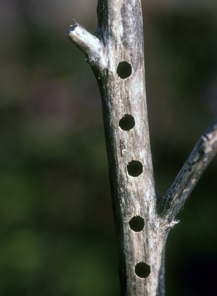
Female of Hoplitis (Alcidamea) tridentata (Dufour & Perris, 1840) entering her nest in a pithy stem through an entrance hole gnawed by the bee itself (left); emergence holes gnawed by the freshly eclosed imagines of H. tridentata (right). Fotos A. Krebs.
Species accounts
Hoplitis (Alcidamea) acanthophora (Morawitz, 1875)
1875 Osmia acanthophora Morawitz, Travel to Turkestan by A. P. Fedtschenko, p. 101. Type material: m(m), “in valle Sarafschan” [Tajikistan].-Combination Osmia (Osmia) acanthophora Morawitz in Friese (1911b: 84). Combination Hoplitis (Acanthosmia) acanthophora (Morawitz) in Popov (1960a: 430). Combination Osmia (Alcidamea) acanthophora Morawitz in Warncke (1991h: 720).
Distribution-Northern Asia: TJ. Southwestern Asia: TR.
Identification-Keys, Descriptions: Ducke (1900); Popov (1960a: 430-432).
Nesting biology: Unknown.
Flower preferences: Unknown.
Hoplitis (Alcidamea) acuticornis (Dufour & Perris, 1840)
1840 Osmia acuticornis Dufour & Perris, Annales de la Société Entomologique de France, 9: 14. Type material: Syntypes m(m), f(f), [France].-Combination Osmia (Alcidamea) acuticornis Dufour & Perris in Warncke (1991h: 723).
1877 Osmia dentiventris Morawitz, Horae Societatis Entomologicae Rossicae (St. Petersburg), 14: 45. Type material: Holotype m, “Nikolajewka (Novaja Derewnja)” [Armenia], ZIN (St. Petersburg).-Combination Osmia (Acanthosmia) dentiventris Morawitz in Schmiedeknecht (1885: 21 [887]).-Synonymy in Friese (1893: 355).
Distribution-Europe: A, AL, AND, ARM, AZ, BG, CH, CZ, D, E, E(Ba), F, GR, GR(Aegean Islands, Cr), H, HR, I, I(Si), L, MK, P, RO, RUS(CR,SR), SCG, SK, SLO, UA(Crimea). Northern Africa: MA, DZ, E(Ca), P(Ma), TN. Northern Asia: KS, KZ, RUS(WS,ES), TJ, TM. Southwestern Asia: CY, IL, IR, JOR, RL, SYR, TR.
Identification-Keys, Descriptions: Amiet et al. (2004); Banaszak and Romasenko (2001); Benoist (1931); Ducke (1900); Medvedeva (1978); Móczár (1958); Scheuchl (1996); Schmiedeknecht (1885-1886); Warncke (1991h); Le Divelec (2024).
Nesting biology-Nesting site: Excavated burrows in pithy stems (e.g. Asphodelus, Ferula, Rubus, Scilla, Vitis and others). Nesting material: The cell partitions consist of pressed particles of pith. The nest plug is made of a thick layer of pith and covered by a thinner layer of chewed leaves (rarely also petals); sometimes the nest plug consists only of pith. Typically, the brood cells are slightly constricted at their apex. (Banaszak and Romasenko, 2001; Benoist, 1931; Enslin, 1925, 1933; Grandi, 1961; Le Goff, 1997; Mavromoustakis, 1939b; Stoeckhert, 1954; Westrich, 1989; C. Sedivy and A. Müller, personal observation)
Flower preferences: The species is said to be a strict oligolege of Fabaceae (Amiet et al., 2004; Banaszak and Romasenko, 2001; Westrich, 1989). Indeed, 29 out of 32 pollen samples analysed so far consist of pure Fabaceae pollen, e.g. ; however, three pollen samples from two different localities contain large amounts of pollen of Boraginaceae (Echium, Anchusa). Thus, the species might be better classified as polylectic with a strong preference for Fabaceae (A. Müller, unpublished, based on 32 pollen samples from 29 different localities).
– subspecies acuticornis (Dufour & Perris, 1840)
1840 Automatically established nominotypical subspecific taxon (original description and type specimen are identical with those of the species rank taxon of the same name above).
Distribution-Europe: A, AL, AND, ARM, AZ, CH, CZ, D, F, GR, GR(Aegean Islands, Cr), H, HR, I, I(Si), L, MK, RO, RUS(CR,SR), SCG, SK, SLO, UA(Crimea). Northern Africa: DZ, P(Ma), TN. Southwestern Asia: CY, IR, JOR, RL, SYR, TR.
Identification-Keys, Descriptions: No supplementary or more detailed morphological description known.
– subspecies brunneipes (Peters, 1975)
1975 Osmia acuticornis brunneipes Peters, Senckenbergiana Biologica (Frankfurt), 56: 50. Type material: Holotype f, “Gran Canaria: San Bartolomé” [Spain: Canary Islands], SMFD (Frankfurt); paratypes m, ff.
Distribution-Northern Africa: E(Ca).
Identification-Keys, Descriptions: Tkalcu (1993b: 811).
– subspecies camelina (Benoist 1934)
1934 Osmia camelina Benoist, Bulletin de la Société Entomologique de France, 39: 106. Type material: Holotype f, “Ain Leuh” [Morocco], MNHN (Paris).-Combination Osmia (Alcidamea) acuticornis camelina Benoist in Warncke (1991h: 724). Combination Hoplitis (Alcidamea) camelina (Benoist) in Zanden (1996b: 884).
Distribution-Northern Africa: MA, TN?.
Identification-Keys, Descriptions: Warncke (1991h); Zanden (1985: 63).
– subspecies gilva Zanden, 1994
1994 Hoplitis (Alcidamea) acuticornis gilvus Zanden, Reichenbachia (Dresden), 30: 169. Type material: Holotype f, “Tschatkal-Gebirge, Arkit, 1250 m” [Tajikistan], ZMUM (Moscow); paratype f.
Distribution-Northern Asia: KS, KZ, RUS(WS,ES), TJ, TM.
Identification-Keys, Descriptions: No supplementary or more detailed morphological description known. Note: Male unknown.
– subspecies hispanica (Schmiedeknecht, 1886)
1886 Osmia (Acanthosmia) hispanica Schmiedeknecht, Apidae Europaeae, vol. 2, p. 140 [1006]. Type material: Syntypes m(m), f(f), [Spain].-Synonymy with Osmia acuticornis Dufour & Perris in Dalla Torre (1896: 383). Synonymy with Osmia dentiventris Morawitz in Friese (1891: 260).-Combination Osmia (Alcidamea) acuticornis hispanica Schmiedeknecht in Warncke (1991h: 724).
Distribution-Europe: E, E(Ba), P.
Identification-Keys, Descriptions: No supplementary or more detailed morphological description known.
Hoplitis (Alcidamea) agnielae Le Divelec, 2024
2024 Hoplitis agnielae Le Divelec, Annales de la Société Entomologique de France. Type material: Holotype f, “Mausoléo, Corsica” [France]; paratypes ff, mm.
Distribution-Europe: F(Co), I(Sa).
Identification-Keys, Descriptions: No supplementary or more detailed morphological description known.
Nesting biology: Unknown.
Flower preferences: Probably mesolectic on Fabaceae (e.g. Lotus) and Echium (Boraginaceae) (A. Müller, unpublished, based on 3 pollen samples from 3 different localities).
Hoplitis (Alcidamea) antennata (Morawitz, 1875)
1875 Osmia antennata Morawitz, Horae Societatis Entomologicae Rossicae (St. Petersburg), 12: 43. Type material: Lectotype m, by designation of Warncke (1991h: 723), “auf dem Berge Schaffnabadell” [Armenia], ZIN (St. Petersburg).-Combination Osmia (Alcidamea) antennata Morawitz in Warncke (1991h: 723).
Distribution-Europe: ARM. Southwestern Asia: TR.
Identification-Keys, Descriptions: Ducke (1900); Schmiedeknecht (1885-1886); Warncke (1991h).
Nesting biology: Unknown.
Flower preferences: Unknown. Flower records: Campanula (Morawitz, 1876).
Hoplitis (Alcidamea) arenivaga Zanden, 1996
1996 Hoplitis (Alcidamea) arenivaga Zanden, Linzer Biologische Beiträge, 28: 886. Type material: Holotype m, “80 km N.E. Aqaba (Strasse nach Amman)” [Jordan], OLML (Linz).
Distribution-Southwestern Asia: JOR.
Identification-Keys, Descriptions: No supplementary or more detailed morphological description known. Note: Female unknown.
Nesting biology: Unknown.
Flower preferences: Unknown.
Hoplitis (Alcidamea) beijingensis Wu, 1987
1987 Hoplitis (Liosmia) beijingensis Wu, Acta Entomologica Sinica (Beijing), 30: 443, 448. Type material: Holotype m, “Beijing: Quinlunqiao” [China], IZCAS (Beijing); paratypes mm, ff.
Distribution-Northern Asia: RC(NO), RUS(ES).
Identification-Keys, Descriptions: Wu (2006).
Nesting biology: Unknown.
Flower preferences: Unknown.
Hoplitis (Alcidamea) bicallosa (Morawitz, 1875)
1875 Osmia bicallosa Morawitz, Horae Societatis Entomologicae Rossicae (St. Petersburg), 12: 44. Type material: Lectotype f, by designation of Warncke (1991h: 726), “Borshom” [Georgia], ZIN (St. Petersburg).-Combination Hoplitis (Acanthosmia) bicallosa (Morawitz) in Zanden (1988b: 120). Combination Osmia (Alcidamea) bicallosa Morawitz in Warncke (1991h: 726).
Distribution-Europe: GE, GR. Southwestern Asia: TR.
Identification-Keys, Descriptions: Ducke (1900); Schmiedeknecht (1885-1886); Warncke (1991h).
Nesting biology-Nesting site: Bees were observed at an old post, which indicate that insect burrows might have been used as nesting site. Nesting material: Unknown. (Morawitz, 1876)
Flower preferences: Possibly oligolectic on Fabaceae (A. Müller, unpublished, based on 5 pollen samples from 5 different localities).
Hoplitis (Alcidamea) bispinosa Zanden, 1992
1992 Hoplitis (Liosmia) bispinosa Zanden, Linzer Biologische Beiträge, 24: 820. Type material: Holotype m, “Yüksekova, 2250 m” [Turkey], RMNH (Leiden); paratypes mm.
Distribution-Europe: GR. Southwestern Asia: TR.
Identification-Keys, Descriptions: No supplementary or more detailed morphological description known. Note: Female unknown.
Nesting biology: Unknown.
Flower preferences: Two pollen samples from 2 different localities consist of pollen of Campanulaceae (A. Müller, unpublished).
Hoplitis (Alcidamea) brachypogon (Pérez, 1879)
1879 Osmia brachypogon Pérez, Actes de la Société Linnéenne de Bordeaux, 33: 195. Type material: Lectotype f, by designation of Tkalcu (1974c: 331), “Marseille” [France], MNHN (Paris).-Combination Hoplitis (Acanthosmia) brachypogon (Pérez) in Zanden (1988b: 120). Combination Osmia (Alcidamea) brachypogon Pérez in Warncke (1991h: 719). Combination Hoplitis (Prionohoplitis) brachypogon (Pérez) in Michener (2007) and Ungricht et al. (2008).
1934 Osmia Seyrigi Benoist, Bulletin de la Société Entomologique de France, 39: 106. Type material: Holotype m, “El Solidado” [Spain], MNHN (Paris).-Combination Hoplitis (Liosmia) seyrigi (Benoist) in Zanden (1985: 63). Combination Hoplitis (Alcidamea) seyrigi (Benoist) in Zanden (1988b: 120).-Synonymy in Warncke (1991h: 719) and in Zanden (1991b: 352).
Distribution-Europe: AL, BG, E,F, GR, GR(Cr), HR, I, P. Southwestern Asia: IL, IR, SYR,TR.
Identification-Keys, Descriptions: Amiet et al. (2004); Benoist (1931); Ducke (1900); Tkalcu (1974c: 331); Warncke (1991h); Zanden (1988a: 63, 1991b: 357-358).
Nesting biology: Unknown.
Flower preferences: Possibly mesolectic on Fabaceae, Lamiaceae and Antirrhineae; one pollen load contains small amounts of Brassicaceae pollen suggesting that flowers of this plant family are occasionally exploited as well (A. Müller, unpublished, based on 15 pollen samples from 9 different localities). The female clypeus is covered with a dense yellowish pilosity composed of short, erect and minutely barbed hairs. This specialized pilosity might be an adaptation to collect pollen from nototribic flowers as is suggested by the finding that large pollen quantities adhering to the clypeal hairs of a female of the subspecies H. b. carsophila originated from Antirrhineae and Lamiaceae of the subfamilies Nepetoideae and probably Lamioideae (A. Müller, unpublished). Flower records: Stachys recta (A. Müller, unpublished).
– subspecies brachypogon (Pérez, 1879)
1879 Automatically established nominotypical subspecific taxon (original description and type specimen are identical with those of the species rank taxon of the same name above).
Distribution-Europe: E, F, P.
Identification-Keys, Descriptions: No supplementary or more detailed morphological description known.
– subspecies carsophila (Ducke, 1899)
1899 Osmia carsophila Ducke, Entomologische Nachrichten (Berlin), 25: 212. Type material: Holotype m, “bei Fiume” [Croatia], ZMHB (Berlin).-Synonymy with Osmia brachypogon Pérez in Benoist (1945: 28).-Combination Osmia (Alcidamea) brachypogon carsophila Ducke in Warncke (1991h: 719). Combination Hoplitis (Prionohoplitis) brachypogon carsophila (Ducke) in Ungricht et al. (2008).
Distribution-Europe: AL, BG, GR, GR(Cr), HR, I. Southwestern Asia: IL, IR, SYR, TR.
Identification-Keys, Descriptions: Warncke (1991h).
Hoplitis (Alcidamea) campanularis (Morawitz, 1877)
1877 Osmia campanularis Morawitz, Horae Societatis Entomologicae Rossicae (St. Petersburg), 14: 42. Type material: Lectotype f, by designation of Warncke (1991h: 735), “Mzchett” [Georgia], ZIN (St. Petersburg).-Combination Hoplitis (Acanthosmia) campanularis (Morawitz) in Zanden (1988b: 120). Combination Osmia (Alcidamea) campanularis Morawitz in Warncke (1991h: 735). Combination Hoplitis (Prionohoplitis) campanularis (Morawitz) in Michener (2007) and Ungricht et al. (2008).
Distribution-Europe: AL, BG, E, GE, GR, HR, I, P, RUS(SR), SCG, SLO. Northern Africa: DZ, MA. Southwestern Asia: IL, RL, TR.
Identification-Keys, Descriptions: Schmiedeknecht (1885-1886); Warncke (1991h).
Nesting biology: Unknown.
Flower preferences: Oligolectic on Campanulaceae (e.g. Asyneuma) (Morawitz, 1877; A. Müller, unpublished, based on 21 pollen samples from 13 different localities).
– subspecies campanularis (Morawitz, 1877)
1877 Automatically established nominotypical subspecific taxon (original description and type specimen are identical with those of the species rank taxon of the same name above).
Distribution-Europe: AL, BG, GE, GR, HR, I, RUS(SR), SCG, SLO. Southwestern Asia: IL, RL, TR.
Identification-Keys, Descriptions: No supplementary or more detailed morphological description known.
– subspecies ibericola (Mavromoustakis, 1947)
1947 Osmia digitata ibericola Mavromoustakis, Eos (Madrid), 23: 357. Type material: Holotype m, “Paracuellos” [Spain], DAAN (Nicosia).-Combination Osmia (Alcidamea) campanularis ibericola Mavromoustakis in Warncke (1991h: 735). Combination Hoplitis (Prionohoplitis) campanularis ibericola (Mavromoustakis) in Ungricht et al. (2008).
Distribution-Europe: E,P.
Identification-Keys, Descriptions: Warncke (1991h); Zanden (1984c: 182).
– subspecies sexcinctella (Pérez, 1895)
1895 Osmia sexcinctella Pérez, Espèces nouvelles de mellifères de Barbarie, p. 14. Type material: f(f), [Algeria], MNHN (Paris).-Combination Hoplitis (Hoplitis) sexcinctella (Pérez) in Zanden (1988b: 121). Combination Osmia (Alcidamea) campanularis sexcinctella Pérez in Warncke (1991h: 736). Combination Hoplitis (Prionohoplitis) campanularis sexcinctella (Pérez) in Ungricht et al. (2008).
1899 Osmia digitata Friese, Entomologische Nachrichten (Berlin), 25: 61. Type material: Holotype m, “Algeria” [Algeria], ZMHB (Berlin).-Synonymy with Hoplitis campanularis (Morawitz in Zanden (1988b: 115, 120). Synonymy with Osmia campanularis sexcinctella Pérez in Warncke (1991h: 736).
Distribution-Northern Africa: DZ, MA.
Identification-Keys, Descriptions: Ducke (1900).
Hoplitis (Alcidamea) capsulifer Popov, 1960
1960 Hoplitis (Liosmia) capsulifer Popov, Izvestiya Otdeleniya Sel’skochozyaistvennich i Biologicheskich Nauk, 2: 73. Type material: Syntypes mm, ff, [Tajikistan], ZIN (St. Petersburg).-Combination Osmia (Alcidamea) capsulifer (Popov) in Warncke (1991h: 718).
Distribution-Northern Asia: KS, KZ, TJ, UZ; Central Asian Ranges.
Identification-Keys, Descriptions: No supplementary or more detailed morphological description known.
Nesting biology: Unknown.
Flower preferences: Unknown.
Hoplitis (Alcidamea) caucasica (Friese, 1920)
1920 Osmia caucasica Friese, Deutsche Entomologische Zeitschrift (Berlin), 1920: 51. Type material: Syntypes ff, “Murut im Kaukasus” [Azerbajian], ZMHB (Berlin).-Combination Hoplitis (Megalosmia) caucasica (Friese) in Zanden (1988b: 122). Combination Osmia (Alcidamea) caucasica Friese in Warncke (1991h: 721).
Distribution-Europe: AZ, RUS(SR). Southwestern Asia: TR.
Identification-Keys, Descriptions: Warncke (1991h).
Nesting biology: Unknown.
Flower preferences: Unknown. Flower records: Onobrychis, Melilotus (Özbek, 1979b).
Hoplitis (Alcidamea) caularis (Morawitz, 1875)
1875 Osmia caularis Morawitz, Travel to Turkestan by A. P. Fedtschenko, p. 94. Type material: Holotype f, “Bajbek in deserto Kisilkum” [Kazakhstan], ZIN (St. Petersburg).-Combination Hoplitis (Acanthosmia) caularis (Morawitz) in Zanden (1988b: 120). Combination Osmia (Alcidamea) caularis Morawitz in Warncke (1991h: 726).
Distribution-Northern Asia: KS?, KZ, RC?, TM?, UZ?. Southwestern Asia: SYR?, TR?.
Identification-Keys, Descriptions: Fateryga and Proshchalykin (2020); Medvedeva (1978); Warncke (1991h); Wu (2006).
Nesting biology: Unknown.
Flower preferences: Possibly oligolectic on Fabaceae (A. Müller, unpublished, based on 4 pollen samples from 4 different localities).
Hoplitis (Alcidamea) claviventris (Thomson, 1872)
1861 Osmia interrupta Schenck, Jahrbücher des Vereins für Naturkunde im Herzogthum Nassau, 14: 341. NOMEN PRAEOCCUPATUM [not Osmia interrupta Latreille, 1811]. Type material: Lectotype m, by designation of Tkalcu (1974b: 330), [Germany], SMFD (Frankfurt).
1872 Osmia claviventris Thomson, Skandinaviens Hymenoptera, vol. 2, p. 254. Type material: Lectotype m, by designation of Tkalcu (1974b: 331), “Norrland” [Sweden], MZLU (Lund). Type species of Liosmia Thomson.-Combination Hoplitis (Liosmia) claviventris (Thomson) in Tkalcu (1974b: 330). Combination Osmia (Alcidamea) claviventris Thomson in Warncke (1991h: 717).
1873 Osmia foveolata Schenck, Berliner Entomologische Zeitschrift, 17: 249 [not seen]. Type material: f(f). NOMEN NOVUM with same type specimen for preoccupied Osmia interrupta Schenck, 1861 [not Osmia interrupta Latreille, 1811].
Distribution-Europe: A,AL, B, BG, BIH, BY, CH, CZ, D, DK, E, EST, F, F(Co)?, FIN, FL, GB, GR, H, HR, I, I(Sa), I(Si), L, LT, LV, MK, N, NL, P, PL, RO, RUS(CR,SR), S, SCG, SK, SLO, UA, UA(Crimea); Caucasus. Northern Asia: KZ, MGL, RC, RUS(WS,ES). Southwestern Asia: TR.
Identification-Keys, Descriptions: Amiet et al. (2004); Banaszak and Romasenko (2001); Benoist (1931, as Osmia leucomelana); Ducke (1900); Scheuchl (1996); Medvedeva (1978, as Hoplitis leucomelana); Móczár (1958, as Osmia leucomelana); Radoszkowski (1887a: 281); Romankova (1995, as Hoplitis leucomelana); Schmiedeknecht (1885-1886); Warncke (1991h); Wu (2006, as Hoplitis leucomelana). Misapplication: In many publications Hoplitis leucomelana auct. [not (Kirby, 1802)] is Hoplitis claviventris (Thomson), see Yarrow (1970).
Nesting biology-Nesting site: Excavated burrows in pithy stems (e.g. Rosa, Rubus, Sambucus, Verbascum, Artemisia, Onopordum, Cirsium, Arctium) or in decaying wood and twigs (e.g. Fagus); insect burrows in dead wood; hollow stems. Nesting material: Cell partitions and nest plug are made of masticated leaf material (e.g. Rosa). The space (8-12mm long) between outermost cell partition and nest plug is sometimes filled with pebbles or grass spikes. (Amiet et al., 2004; Banaszak and Romasenko, 2001; Benoist, 1931; Borries, 1897; Enslin, 1925, 1933; Friese, 1923; Grandi, 1961; Höppner, 1904; Le Goff, 2001; Schmiedeknecht, 1885-1886; Stoeckhert, 1933; Westrich, 1989; A. Gogala, personal communication)
Flower preferences: Polylectic with a preference for Fabaceae; additional pollen sources include Cistaceae, Lamiaceae, Asteraceae, Boraginaceae, Crassulaceae, Hypericaceae and Rosaceae (Amiet et al., 2004; Westrich, 1989; A. Müller, unpublished, based on 5 pollen samples from 5 different localities and field observations).
– subspecies claviventris (Thomson, 1872)
1872 Automatically established nominotypical subspecific taxon (original description and type specimen are identical with those of the species rank taxon of the same name above).
Distribution-Europe: A,AL, B, BG, BIH, BY, CH, CZ, D, DK, E, EST, F, F(Co)?, FIN, FL, GB, GR, H, HR, I, I(Sa), I(Si), L, LT, LV, MK, N, NL, P, PL, RO, RUS(CR), S, SCG, SK, SLO, UA, UA(Crimea); Caucasus. Northern Asia: KZ, MGL, RC, RUS(WS,ES). Southwestern Asia: TR.
Identification-Keys, Descriptions: No supplementary or more detailed morphological description known.
– subspecies columba (Warncke, 1991)
1991 Osmia (Alcidamea) claviventris columba Warncke, Linzer Biologische Beiträge, 23: 717. Type material: Holotype (sex unspecified), “Noguera/Sierra de Albarracin, Prov. Teruel, 1600 m” [Spain], OLML (Linz); paratypes m(m), f(f).
Distribution-Europe: E.
Identification-Keys, Descriptions: No supplementary or more detailed morphological description known.
Hoplitis (Alcidamea) contracta (Walker, 1871)
1871 Osmia contracta Walker, List of Egyptian and Arabian Hymenoptera, p. 47. Type material: Syntypes m(m), f(f), “Harkeko. Dahleck” [Eritrea].-Combination Hoplitis (Tridentosmia) contracta (Walker) in Zanden (1988b: 122).
Distribution-Northern Africa: ET. Southwestern Asia: Arabia.Extralimital: Afrotropis (Eritrea).
Identification-Keys, Descriptions: No supplementary or more detailed morphological description known.
Nesting biology: Unknown.
Flower preferences: Unknown.
Hoplitis (Alcidamea) curtula (Pérez, 1895)
1895 Osmia curtula Pérez, Espèces nouvelles de mellifères de Barbarie, p. 16. Type material: Lectotype f, by designation of Zanden (1989: 77), “Barcelone” [Spain], MNHN (Paris).-Combination Hoplitis (Liosmia) curtula (Pérez) in Zanden (1989: 76). Combination Osmia (Alcidamea) curtula Pérez in Warncke (1991h: 729).
1905 Osmia bofilli Pérez, Butlletí de la Institució Catalana d’Història Natural, 5: 82. Type material: Lectotype m, by designation of Zanden (1989: 77), “Barcelone” [Spain], MNHN (Paris); paralectotype f.-Synonymy in Zanden (1989: 76).
Distribution-Europe: E, F. Northern Africa: DZ, MA. Southwestern Asia: TR.
Identification-Keys, Descriptions: Tkalcu (2000a: 316-318); Warncke (1991h); Zanden (1989: 77). Misapplication: The material examined and figured by Warncke (1991h) under the name Osmia curtula belongs to Hoplitis mollis, see Tkalcu (2000a: 318).
Nesting biology: Unknown.
Flower preferences: Unknown.
Hoplitis (Alcidamea) decaocta (Warncke, 1991)
1991 Osmia (Alcidamea) decaocta Warncke, Linzer Biologische Beiträge, 23: 732. Type material: Holotype f, “Erçek/Van” [Turkey], OLML (Linz); paratype f.
Distribution-Southwestern Asia: TR.
Identification-Keys, Descriptions: No supplementary or more detailed morphological description known. Note: Male unknown.
Nesting biology: Unknown.
Flower preferences: Unknown. The only pollen sample available so far consists of pollen of Hedysareae (Fabaceae) (A. Müller, unpublished).
Hoplitis (Alcidamea) eburnea (Warncke, 1991)
1991 Osmia (Alcidamea) eburnea Warncke, Linzer Biologische Beiträge, 23: 738. Type material: Holotype f, “10 km W Uludere in 1000 m/Hakkari” [Turkey], OLML (Linz); paratypes m(m), f(f).- Combination Hoplitis (Prionohoplitis) eburnea (Warncke) in Michener (2007) and Ungricht et al. (2008).
Distribution-Europe: AZ. Southwestern Asia: IL, SYR,TR.
Identification-Keys, Descriptions: No supplementary or more detailed morphological description known.
Nesting biology: Unknown.
Flower preferences: Possibly oligolectic on Haplophyllum (Rutaceae) (A. Müller, unpublished, based on 5 pollen samples from 2 different localities).
Hoplitis (Alcidamea) fossulata (Mocsary, 1883)
1883 Stelis fossulata Mocsary, Ertekezések A Természettudományok Köreböl, 13: 69. Type material: Holotype m, “Persia” [Iran], HNHM (Budapest).-Combination Osmia (Alcidamea) fossulata (Mocsary) in Warncke (1991h: 732).
Distribution-Southwestern Asia: IR.
Identification-Keys, Descriptions: Zanden (1988a: 63). Note: Female unknown.
Nesting biology: Unknown.
Flower preferences: Unknown.
Hoplitis (Alcidamea) freygessneri (Friese, 1899)
1899 Osmia freygessneri Friese, Entomologische Nachrichten (Berlin), 25: 26. Type material: Syntypes m(m), f(f), “Biskra” [Algeria], ZMHB (Berlin).-Combination Hoplitis (Liosmia) freygessneri (Friese) in Zanden (1988b: 122).
1991 Osmia (Alcidamea) alectoris Warncke, Linzer Biologische Beiträge, 23: 727. NOMEN NOVUM with same type specimen for preoccupied Osmia freygessneri Friese, 1899 [not Heriades freygessneri Schletterer, 1889].
Distribution-Northern Africa: DZ, MA, TN. Extralimital: Oriental (India).
Identification-Keys, Descriptions: Ducke (1900); Tkalcu (1977b: 231-232).
Nesting biology-Nesting site: Hollow and upright, broken stems of Arundo donax. Nesting material: Cell partitions and nest plug are made of chewed leaves (e.g. Peganum) and probably also of chewed flowers (C. Sedivy and A. Müller, personal observation).
Flower preferences: Polylectic, important pollen sources are Reseda (Resedaceae) and Peganum (Zygophyllaceae), Fabaceae are used as well (A. Müller, unpublished, based on 23 pollen samples from 11 different localities, provisions of 9 brood cells belonging to 3 different nests from the same locality as well as field observations).
Hoplitis (Alcidamea) galbula (Warncke, 1991)
1991 Osmia (Alcidamea) galbula Warncke, Linzer Biologische Beiträge, 23: 736. Type material: Holotype m, “15 km NW Yüksekova in 1500 m/Hakkari” [Turkey], OLML (Linz); paratypes mm.
Distribution-Europe: GR. Southwestern Asia: TR.
Identification-Keys, Descriptions: No supplementary or more detailed morphological description known. Note: Female unknown.
Nesting biology: Unknown.
Flower preferences: Unknown.
Hoplitis (Alcidamea) garzetta (Warncke, 1991)
1991 Osmia (Alcidamea) garzetta Warncke, Linzer Biologische Beiträge, 23: 730. Type material: Holotype m, “Nemrut Dag in 2850 m/Bitlis” [Turkey], OLML (Linz); paratypes mm, ff.
Distribution-Europe: GR. Southwestern Asia: TR.
Identification-Keys, Descriptions: No supplementary or more detailed morphological description known.
Nesting biology: Unknown.
Flower preferences: Unknown.
Hoplitis (Alcidamea) grandiscapa (Pérez, 1895)
1895 Osmia grandiscapa Pérez, Espèces nouvelles de mellifères de Barbarie, p. 16. Type material: m(m), [Algeria], MNHN (Paris).-Combination Osmia (Alcidamea) grandiscapa Pérez in Warncke (1991h: 717).
Distribution- Europe: I(Sa)?. Northern Africa: DZ; MA.
Identification-Keys, Descriptions: Alfken (1937: 107); Ducke (1900); Warncke (1991h).
Nesting biology: Unknown.
Flower preferences: Unknown.
Hoplitis (Alcidamea) grossepunctata (Kohl, 1905)
1905 Osmia grossepunctata Kohl, Annalen des Kaiserlich-Königlichen Naturhistorischen Hofmuseums (Wien), 20: 242. Type material: Holotype m, “Erdschias (Ewlije-Dagh)” [Turkey], NMW (Wien).-Combination Hoplitis (Hoplitis) grossepunctata (Kohl) in Zanden (1988b: 121). Combination Osmia (Alcidamea) grossepunctata Kohl in Warncke (1991h: 740). Combination Hoplitis (Prionohoplitis) grossepunctata (Kohl) in Michener (2007) and Ungricht et al. (2008).
Distribution- Europe: ARM, BG, GR, GR(Aegean Islands). Northern Asia: TM. Southwestern Asia: SYR, TR.
Identification-Keys, Descriptions: Mavromoustakis (1938: 469); Warncke (1991h); Zanden (1989: 73).
Nesting biology: Unknown.
Flower preferences: Possibly oligolectic on Allium (Alliaceae) (A. Müller, unpublished, based on 1 pollen sample and on flower records on labels).
Hoplitis (Alcidamea) heilungjiangensis Wu, 1987
1987 Hoplitis (Liosmia) heilungjiangensis Wu, Acta Entomologica Sinica (Beijing), 30: 444, 449. Type material: Holotype m, “Heilujiang, Harbin” [China], IZCAS (Beijing); paratype m.
Distribution-Northern Asia: RC(NE).
Identification-Keys, Descriptions: Wu (2006). Note: Female unknown.
Nesting biology: Unknown.
Flower preferences: Unknown.
Hoplitis (Alcidamea) herrmanni Müller, 2022
2022 Hoplitis (Alcidamea) herrmanni Müller, Zootaxa, 5188: 234. Type material: Holotype m, “Layoune” [Morocco], ETH (Zurich); paratypes mm.
Distribution-Northern Asia: MA.
Identification-Keys, Descriptions: No supplementary or more detailed morphological description known. Note: Female unknown.
Nesting biology: Unknown.
Flower preferences: Unknown.
Hoplitis (Alcidamea) hofferi Tkalcu, 1977
1977 Hoplitis (Liosmia) hofferi Tkalcu, Vestnik Ceskoslovenske Spolecnosti Zoologicke, 41: 229. Type material: Holotype m, “Quetta” [Pakistan], BMNH (London).
1991 Osmia (Alcidamea) alexandrina Warncke, Linzer Biologische Beiträge, 23: 728. Type material: Holotype f, “Zisterne 12 km W Mizpe Ramon” [Israel], OLML (Linz); paratypes m(m), f(f).-New synonymy, based on types and original description (A. Müller, unpublished).
Distribution-Northern Africa: ET. Southwestern Asia: IL, IR, JOR, OM, PAK, SYR, UAE.
Identification-Keys, Descriptions: No supplementary or more detailed morphological description known.
Nesting biology: Unknown.
Flower preferences: Polylectic, pollen sources include Resedaceae (e.g. Ochradenus), Fabaceae, Boraginaceae (e.g. Echium), Haplophyllum (Rutaceae) and Peganum (Zygophyllaceae) (A. Müller, unpublished, based on 17 pollen samples from 11 different localities).
Hoplitis (Alcidamea) irania (Warncke, 1991)
1991 Osmia (Alcidamea) irania Warncke, Linzer Biologische Beiträge, 23: 739. Type material: Holotype m, “Pass O Neyriz in 2060 m/Fars” [Iran], OLML (Linz); paratypes mm, f.
Distribution-Northern Asia: TM. Southwestern Asia: IR.
Identification-Keys, Descriptions: No supplementary or more detailed morphological description known.
Nesting biology: Unknown.
Flower preferences: Unknown.
Hoplitis (Alcidamea) laminifera Popov, 1960
1960 Hoplitis (Acanthosmia) laminifera Popov, Entomologicheskoe Obozrenie, 39: 433. Type material: Syntypes m, f, “River Kondara, 1110 m, Gissar Ridge” [Tajikistan], ZIN (St. Petersburg).-Combination Hoplitis (Acanthosmia) laminifera Popov in Zanden (1988b: 120). Combination Osmia (Alcidamea) laminifera (Popov) in Warncke (1991h: 725).
Distribution-Northern Asia: TJ, UZ.
Identification-Keys, Descriptions: No supplementary or more detailed morphological description known.
Nesting biology: Unknown.
Flower preferences: Unknown.
Hoplitis (Alcidamea) lecerfi (Benoist, 1928)
1928 Osmia Le Cerfi Benoist, Bulletin de la Société des Sciences Naturelles du Maroc (Rabat), 8: 213. Type material: Lectotype m, by designation of Zanden (1985: 52), “Grand Atlas, au sud de Marrakech, région du Tizi n’Test et du Djebel Imdress (2000 à 2450 m). Tinmel (1400 m)” [Morocco], MNHN (Paris); paralectotypes m, f.-Combination Osmia (Alcidamea) lecerfi Benoist in Warncke (1991h: 720).
Distribution-Northern Africa: MA.
Identification-Keys, Descriptions: Warncke (1991h); Zanden (1985: 52-53).
Nesting biology: Unknown.
Flower preferences: Unknown.
Hoplitis (Alcidamea) limassolica (Mavromoustakis, 1937)
1937 Osmia limassolica Mavromoustakis, The Annals and Magazine of Natural History (London), 20: 523. Type material: Holotype f, “Limassol” [Cyprus], DAAN (Nicosia); paratypes mm, ff.-Combination Hoplitis (Liosmia) limassolica (Mavromoustakis) in Zanden (1988b: 122). Combination Osmia (Alcidamea) limassolica Mavromoustakis in Warncke (1991h: 729).
Distribution-Northern Africa: TN. Southwestern Asia: CY, IL, JOR, TR.
Identification-Keys, Descriptions: Warncke (1991h).
Nesting biology-Nesting site: Dry stems of Asphodelus. Nesting material: Unknown. The cells are separated by double partitions. (Mavromoustakis, 1948c)
Flower preferences: Possibly mesolectic on Fabaceae and Boraginaceae (Echium, Anchusa) (A. Müller, unpublished, based on 13 pollen samples from 12 different localities and on field observations). The females possess long and curved bristles on the tarsi of their forelegs, which serve to extract pollen from the narrow-tubed flowers of Anchusa (A. Müller, unpublished).
Hoplitis (Alcidamea) loboclypeata Wu, 1990
1990 Hoplitis loboclypeata Wu, Entomotaxonomia (Yangling), 12: 245, 250. Type material: Holotype f, “Inner Mongolia: Zhenglan B., Xilin Gol L.” [China], IZCAS (Beijing); paratype f.
Distribution-Northern Asia: RC(NO).
Identification-Keys, Descriptions: Wu (2006). Note: Male unknown.
Nesting biology: Unknown.
Flower preferences: Unknown.
Hoplitis (Alcidamea) mollis Tkalcu, 2000
2000 Hoplitis (Liosmia) mollis Tkalcu, Acta Societatis Zoologicae Bohemoslovacae (Praha), 64: 316. Type material: Holotype m, “Erzurum” [Turkey], Tkalcu Collection (Praha); paratypes mm, ff.
Distribution-Europe: AZ, BG, RUS(SR), UA, UA(Crimea). Northern Asia: KS, KZ, UZ. Southwestern Asia: JOR, SYR, TR.
Identification-Keys, Descriptions: Warncke (1991h, as Osmia curtula). Misapplications: The material examined and figured by Warncke (1991h) under the name Osmia curtula belongs to Hoplitis mollis, see Tkalcu 2000a: 318. Specimens from Ukraine and Astrakhan assumed to be Hoplitis (Alcidamea) turcestanica by Fateryga and Proshchalykin, 2020) belong to Hoplitis (Alcidamea) mollis (Ukraine) and a still undescribed H. (Alcidamea) species (Astrakhan). “Hoplitis turcestanica” in Banaszak and Romasenko (2001), Medvedev (1978) and Osytshnjuk et al. (1978) likely refers to H. mollis.
Nesting biology-Nesting site: Similar to Hoplitis (Alcidamea) praestans, i.e. in excavated burrows in the pith of dry stems (Banaszak and Romasenko, 2001, as H. turcestanica); reared from a trap nest (Fateryga and Proshchalykin, 2020, as H. turcestanica). Nesting material: Similar to Hoplitis (Alcidamea) praestans, i.e. masticated green leaves (Banaszak and Romasenko, 2001, as H. turcestanica).
Flower preferences: Possibly oligolectic on Fabaceae (Özbek, 1979b; A. Müller, unpublished, based on 11 pollen samples from 5 different localities).
Hoplitis (Alcidamea) nigrocolor (Zanden, 1991)
1991 Anthocopa (Anthocopa) nigrocolor Zanden, Linzer Biologische Beiträge, 23: 346. Type material: Holotype f, “Matruh G.” [Egypt], RMNH (Leiden); paratypes ff.
1991 Osmia (Alcidamea) acuticornis penelope Warncke, Linzer Biologische Beiträge, 23: 724. Type material: Holotype m, “7 km SW Zarzis” [Tunisia], OLML (Linz); paratypes mm.-Synonymy with Hoplitis camelina (Benoist) in Zanden (1996b: 884), rejected by A. Müller (unpublished). New synonymy (A. Müller, unpublished).
Distribution-Northern Africa: ET, LAR, TN.
Identification-Keys, Descriptions: No supplementary or more detailed morphological description known.
Nesting biology: Unknown.
Flower preferences: Unknown.
Hoplitis (Alcidamea) occidentalis Müller, 2012
2012 Hoplitis (Alcidamea) occidentalis Müller, Zootaxa, 3355: 38. Type material: Holotype m, “80km SW of Valencia, Muela de Cortes reserv.” [Spain], ETHZ (Zurich); paratypes mm, ff.
Distribution-Europe: E, F, I(Sa). Northern Africa: MA.
Identification-Keys, Descriptions: No supplementary or more detailed morphological description known.
Nesting biology: Unknown.
Flower preferences: Polylectic; pollen sources known so far include Fabaceae, Cistaceae and Campanulaceae (Müller, 2012a).
Hoplitis (Alcidamea) ozbeki Tkalcu, 2000
2000 Hoplitis (Liosmia) ozbeki Tkalcu, Acta Societatis Zoologicae Bohemoslovacae (Praha), 64: 313. Type material: Holotype m, “Erzurum Serceme” [Turkey], EMET (Erzurum); paratype f.
Distribution-Europe: GE, RUS(SR). Southwestern Asia: TR.
Identification-Keys, Descriptions: No supplementary or more detailed morphological description known.
Nesting biology: Unknown.
Flower preferences: Unknown.
Hoplitis (Alcidamea) pinkeunia (Warncke, 1991)
1991 Osmia (Alcidamea) pinkeunia Warncke, Linzer Biologische Beiträge, 23: 725. Type material: Holotype m, “Hissar-Geb. N Duschanbe in 2000 m” [Tajikistan], OLML (Linz).
Distribution-Northern Asia: KS, KZ, TJ.
Identification-Keys, Descriptions: No supplementary or more detailed morphological description known. Note: Female unknown.
Nesting biology: Unknown.
Flower preferences: Unknown.
Hoplitis (Alcidamea) praestans (Morawitz, 1894)
1894 Osmia praestans Morawitz, Horae Societatis Entomologicae Rossicae (St. Petersburg), 28: 31. Type material: Syntypes m(m), f(f), “Artutsch” [Tajikistan], ZIN (St. Petersburg).-Combination Hoplitis (Liosmia) praestans (Morawitz) in Zanden (1980: 233). Combination Osmia (Alcidamea) praestans Morawitz in Warncke (1991h: 734).
1895 Osmia lineola Pérez, Espèces nouvelles de mellifères de Barbarie, p. 16. Type material: Lectotype m, by designation of Le Divelec et al. (2024: 179), “Sta. Manza” [France: Corsica], MNHN (Paris); paralectotypes ff, mm.-Synonymy in Zanden (1988b: 122).
Distribution-Europe: A, BG, CH, E, F, F(Co), GR, GR(Aegean Islands), H, HR, I, I(Sa), P, RO, RUS(SR), SCG, SK, SLO, UA, UA(Crimea); Caucasus. Northern Africa: DZ, ET, MA, TN. Northern Asia: KS, KZ, TJ,UZ. Southwestern Asia: IL, IR, JOR, RL, SYR, TR.
Identification-Keys, Descriptions: Amiet et al. (2004); Banaszak and Romasenko (2001); Benoist (1931); Ducke (1900); Medvedeva (1978); Scheuchl (1996); Warncke (1991h).
Nesting biology-Nesting site: Excavated burrows in pithy stems. Nesting material: The cell partitions are made of leaf pulp. (Banaszak and Romasenko, 2001)
Flower preferences: Oligolectic on Campanulaceae (Amiet et al., 2004; Banaszak and Romasenko, 2001; Benoist, 1931; Ducke, 1900; A. Müller, unpublished, based on 12 pollen samples from 8 different localities and field observations)7
Hoplitis (Alcidamea) scita (Eversmann, 1852)
1852 Osmia scita Eversmann, Bulletin de la Société Impériale des Naturalistes de Moscou, 25: 63. Type material: Syntypes m(m), f(f), “in terris transuralensibus” [Russia: Sibiria], presumed lost (Tkalcu, 1995: 122).-Combination Osmia (Osmia) scita Eversmann in Friese (1911b: 106). Combination Osmia (Alcidamea) scita Eversmann in Warncke (1991h: 722). Combination Hoplitis (Liosmia) scita (Eversmann) in Tkalcu (1995: 122).
1879 Osmia rubripes Smith, Description of New Species of Hymenoptera in the Collection of the British Museum, p. 60. Type material: f(f), “Angara River, Siberia” [Russia], BMNH (London).-Combination Hoplitis (Allosmia) rubripes (Smith) in Zanden (1988b: 120). Combination Osmia (Helicosmia) rubripes Smith in Wu (2006: 64).-Synonymy in Tkalcu (1995: 122).
Distribution-Europe: RUS(SR). Northern Asia: KS, MGL, RC, RC(NW), RUS(WS,ES,FS).
Identification-Keys, Descriptions: Ducke (1900); Radoszkowski (1887a: 276-278); Romankova (1994: 120, 1995); Tkalcu (1995: 122-126); Wu (2006).
Nesting biology: Unknown.
Flower preferences: Polylectic, pollen sources include Fabaceae and Lamiaceae (A. Müller, unpublished, based on 8 pollen samples from 7 different localities).
Hoplitis (Alcidamea) stellaris (Warncke, 1991)
1991 Osmia (Alcidamea) stellaris Warncke, Linzer Biologische Beiträge, 23: 731. Type material: Holotype m, “30 km S Baskale in 1700 m/Van” [Turkey], OLML (Linz); paratypes mm.
Distribution-Europe: GR. Southwestern Asia: IR, JOR, SYR, TR.
Identification-Keys, Descriptions: No supplementary or more detailed morphological description known. Note: Female unknown.
Nesting biology: Unknown.
Flower preferences: Unknown. The only pollen sample available so far consist of pollen of Allium (Alliaceae) (A. Müller, unpublished).
Hoplitis (Alcidamea) subbutea (Warncke, 1991)
1991 Osmia (Alcidamea) subbutea Warncke, Linzer Biologische Beiträge, 23: 733. Type material: Holotype m, “Suvari-Halil-Pass in 1900 m/Hakkari” [Turkey], OLML (Linz); paratypes m(m), f(f).
1992 Hoplitis (Liosmia) abnormis Zanden, Linzer Biologische Beiträge, 24: 821. Type material: Holotype m, “Chelmos, Pelopon., 1900 m” [Greece], RMNH (Leiden); paratypes mm.-New synonymy based on topotypical specimens and the original description.
Distribution-Europe: GR. Northern Asia: KZ. Southwestern Asia: IL, IR, TR.
Identification-Keys, Descriptions: No supplementary or more detailed morphological description known.
Nesting biology: Unknown.
Flower preferences: The only pollen sample available so far consists of pollen of Campanulaceae (A. Müller, unpublished).
Hoplitis (Alcidamea) tridentata (Dufour & Perris, 1840)
1840 Osmia tridentata Dufour & Perris, Annales de la Société Entomologique de France, 9: 10. Type material: Syntypes m(m), f(f), [France]. Type species of Tridentosmia Schmiedeknecht.-Combination Hoplitis (Tridentosmia) tridentata (Dufour & Perris) in Zanden (1980: 233). Combination Osmia (Alcidamea) tridentata Dufour & Perrisin Warncke (1991h: 718).
1934 Osmia melanoleuca Benoist, Bulletin de la Société Entomologique de France, 39: 108. Type material: Holotype f, [Algeria], MNHN (Paris).-Combination Hoplitis (Tridentosmia) tridentata melanoleuca (Benoist) in Zanden (1985: 65).-Synonymy in Warncke (1991h: 718).
1975 Hoplitis (Tridentosmia) tridentata asensioi Tkalcu, Archivos del Instituto de Aclimatacion Almeria, 1975: 18. Type material: Holotype f, “Granja Escuela, Valladolid” [Spain], Asensio Collection (Valladolid).-Synonymy with Hoplitis tridentata melanoleuca (Benoist) in Zanden (1985: 65).
Distribution-Europe: A, AZ, B, BG, BY, ARM, CH, CZ, D, E, E(Ba), EST, F, F(Co), GE, GR, H, HR, I, I(Sa), I(Si), L, LT, NL, P, PL, RO, RUS(CR,SR), SCG, SK, SLO, UA, UA(Crimea). Northern Africa: DZ, ET, MA. Northern Asia: KS, KZ, RUS(WS), UZ. Southwestern Asia: IL, IR, SYR,TR.
Identification-Keys, Descriptions: Amiet et al. (2004);Banaszak and Romasenko (2001); Benoist (1931); Ducke (1900); Medvedeva (1978); Móczár (1958); Scheuchl (1996); Schmiedeknecht (1885-1886); Warncke (1991h).
Nesting biology-Nesting site: Excavated burrows in pithy stems (e.g. Ferula, Cirsium, Cynara, Verbascum, Onopordum, Dipsacus, Rubus, Artemisia and others), rarely also in hollow stems (e.g. Dipsacus, Phragmites). The females are able to enter the pithy core of the stems by biting a hole from the side through the wooden wall. The emergence of the adults also often takes place through a hole chewed in the side of the stem. Nesting material: The cell partitions are made of masticated leaves, sometimes mixed with pith. The nest plug consists of several layers of leap pulp alone or of leaf pulp mixed with pith. Larval behaviour: Upon disturbance, the prepupae produce two types of sounds, one of which can be heard up to a distance of 2–3 m (“stroking sounds”), whereas the other is scarcely audible by bare ear (“tapping sounds”). To produce the stroking sounds, the prepupae pull a horseshoe-shaped callosity around the anus over the cocoon wall before they start to produce tapping sounds by knocking a triangularly shaped callosity on the clypeus against the cocoon wall. The production of stroking sounds by a prepupa induces other prepupae of the same nest to stroke and/or to tap resulting in a long-lasting chorusing of numerous prepupae along the whole nest stem. These disturbance sounds probably serve an anti-antagonist function and might possibly have evolved to disturb the reflectance signals that parasitoid wasps use to localize concealed hosts during vibrational sounding. (Banaszak and Romasenko, 2001; Benoist, 1931; Dufour and Perris, 1840; Enslin, 1925, 1933; Friese, 1923; Graeffe, 1902; Grandi, 1961; Le Goff, 1997; Malyshev, 1937; Müller et al., 1997; Westrich, 1989; Ivanov et al., 2019; Müller and Obrist, 2021)
Flower preferences: The species is said to be a strict oligolege of Fabaceae (Amiet et al., 2004; Banaszak and Romasenko, 2001; Westrich, 1989). Indeed, 9 out of 11 pollen samples analysed so far consist of pure Fabaceae pollen; however, two pollen samples from the same locality contain large amounts of pollen of Echium (Boraginaceae). Thus, the species might be better classified as polylectic with a strong preference for Fabaceae (A. Müller, unpublished, based on 11 pollen samples from 9 different localities), which is in line with observations made by Baldock et al. (2018).
Hoplitis (Alcidamea) truncata Wu, 1993
1993 Hoplitis (Liosmia) truncata Wu, Insects of the Hengduan Mountains Region, vol. 2, p. 1393, p. 1419. Type material: Holotype m, “Sichuan: Xiangcheng” [China], IZCAS (Beijing); paratype m.
Distribution-Northern Asia: RC(SW).
Identification-Keys, Descriptions: Wu (2006). Note: Female unknown.
Nesting biology: Unknown.
Flower preferences: Unknown.
Hoplitis (Alcidamea) turcestanica (Dalla Torre, 1896)
1875 Osmia proxima Morawitz, Travel to Turkestan by A. P. Fedtschenko, p. 94. NOMEN PRAEOCCUPATUM [not Osmia proxima Cresson, 1864]. Type material: Lectotype f, by designation of G. van der Zander (Fateryga and Proshchalykin, 2020), “in deserto Kisilkum” [Kazakhstan], ZMUM (Moscow).-Synonymy with Hoplitis caularis (Morawitz) in Warncke (1991h: 726), rejected by Fateryga and Proshchalykin (2020).
1896 Osmia turcestanica Dalla Torre, Catalogus Hymenopterorum, 10: 414. NOMEN NOVUM with same type specimen for preoccupied Osmia proxima Morawitz, 1875 [not Osmia proxima Cresson, 1864].-Combination Osmia (Osmia) turcestanica Dalla Torre in Wu (2006: 50).
Distribution-Northern Asia: KS, KZ, RC?, TM, UZ?.
Identification-Keys, Descriptions: No supplementary or more detailed morphological description known. Note: Male unknown. Misapplication: Specimens from Ukraine and Astrakhan assumed to be Hoplitis (Alcidamea) turcestanica by Fateryga and Proshchalykin, 2020) belong to Hoplitis (Alcidamea) mollis (Ukraine) and a still undescribed H. (Alcidamea) species (Astrakhan). “Hoplitis turcestanica” in Banaszak and Romasenko (2001), Medvedev (1978) and Osytshnjuk et al. (1978) likely refers to H. mollis.
Nesting biology: Unknown.
Flower preferences: Unknown.
Hoplitis (Alcidamea) verruciventris (Morawitz, 1886)
1886 Osmia verruciventris Morawitz, Horae Societatis Entomologicae Rossicae (St. Petersburg), 20: 73. Type material: Lectotype m, by designation of Warncke (1991h: 725), “Talysch-Lirik” [Azerbaijan], ZIN (St. Petersburg).-Combination Osmia (Alcidamea) verruciventris Morawitz in Warncke (1991h: 725).
Distribution-Europe: AZ; Caucasus. Southwestern Asia: TR.
Identification-Keys, Descriptions: Ducke (1900); Warncke (1991h).
Nesting biology: Unknown.
Flower preferences: Unknown.
Hoplitis (Alcidamea) xanthoprymna (Warncke, 1991)
1991 Osmia (Alcidamea) xanthoprymna Warncke, Linzer Biologische Beiträge, 23: 721. Type material: Holotype f, “Madensehir/Konya” [Turkey], OLML (Linz); paratypes ff.
Distribution-Southwestern Asia: TR.
Identification-Keys, Descriptions: No supplementary or more detailed morphological description known. Note: Male unknown.
Nesting biology: Unknown.
Flower preferences: Unknown.
Hoplitis (Alcidamea) xinjiangensis Wu, 1987
1987 Hoplitis (Liosmia) xinjiangensis Wu, Acta Entomologica Sinica (Beijing), 30: 443, 448. Type material: Holotype f, “Xinjiang, Aluotai, Azubai, 1750 m” [China], IZCAS (Beijing).
Distribution-Northern Asia: RC(NW).
Identification-Keys, Descriptions: Wu (2006). Note: Male unknown.
Nesting biology: Unknown.
Flower preferences: Unknown.
leucomelana species group
Hoplitis (Alcidamea) ciliaris (Pérez, 1902)
1902 Osmia ciliaris Pérez, Procès-verbaux de la Société Linnéenne de Bordeaux, 57: 65. Type material: m, “Valence (Drôme)” [France], MNHN (Paris).-Combination Osmia (Alcidamea) ciliaris Pérez in Warncke (1991h: 716).
Distribution-Europe: BG, F, GR, HR, MK, SLO?. Southwestern Asia: IL, IR, RL, TR.
Identification-Keys, Descriptions: Benoist (1931); Warncke (1991h).
Nesting biology: Unknown.
Flower preferences: Probably polylectic. The only pollen sample available so far consists of pollen of Fabaceae (A. Müller, unpublished); Echium (Boraginaceae) and Helianthemum (Cistaceae) are probably additional pollen hosts (Nadimi et al., 2013; A. Gogala, personal communication).
Hoplitis (Alcidamea) leucomelana (Kirby, 1802)
1802 Apis leucomelanaKirby, Monographia Apum Angliae, vol. 2, p. 260. Type material: f(f), [United Kingdom].-Combination Osmia (Liosmia) leucomelana (Kirby) in Thomson (1872: 255). Combination Osmia (Acanthosmia) leucomelana (Kirby) in Schmiedeknecht (1886: 137). Combination Osmia (Alcidamea) leucomelana (Kirby) in Warncke (1991h: 716).
1802 Apis caulicola Schrank, Fauna Boica, vol. 2, p. 383. Type material: f(f), [Germany].-Synonymy in Warncke (1986: 93).
1807 Apis zonata Gravenhorst, Vergleichende Übersicht der Linnéeschen und einiger neueren zoologischen Systeme […], p. 284 [not seen]. NOMEN PRAEOCCUPATUM [not Apis zonata Linnaeus, 1758]. Type material: f(f), [Germany].
1840 Osmia parvula Dufour & Perris, Annales de la Société Entomologique de France, 9: 8. Type material: m(m), f(f), [France].-Synonymy in Warncke (1986: 75).
1863 Heriades bidenticulatus Costa, Atti delle Academia delle Scienze Fisiche e Matematiche (Napoli), 1: 46 [not seen]. Type material: m(m), [Italy].-Combination Chelostoma bidenticulatum (Costa) in Schletterer (1889: 630).-Synonymy in Warncke (1991h: 716).
Distribution-Europe: A, AL, AZ, ARM, B, BG, BY, CH, CZ, D, DK, E, E(Ba), EST, F, F(Co), FIN, FL, GB, GE, H, HR, I, I(Sa), I(Si), FL, L, LT, LV, MK, N, NL, P, PL, RO, RUS(NR,CR,SR), S, SCG, SK, SLO, UA UA(Crimea). Northern Africa: DZ. Northern Asia: MGL, KS, KZ, RC, RC(SW), RUS(WS,ES,FS), TJ. Southwestern Asia: IR, TR.
Identification-Keys, Descriptions: Amiet et al. (2004); Banaszak and Romasenko (2001); Benoist (1931); Ducke (1900); Medvedeva (1978); Móczár (1958); Radoszkowski (1887a: 280-281); Romankova (1995); Scheuchl (1996); Schmiedeknecht (1885-1886); Stanek (1964); Warncke (1991h); Wu (2006, as Hoplitis parvula). Misapplication: In many publications Hoplitis leucomelana auct. [not (Kirby, 1802)] is Hoplitis claviventris (Thomson), see Yarrow (1970).
Nesting biology-Nesting site: Excavated burrows in pithy stems or twigs (e.g. Rubus, Rosa, Verbascum, Onopordum, Artemisia, Acer, Fraxinus, Corylus and others); preexisting cavities in old reed galls of Lipara flies with 1-4 linearly arranged brood cells. Nesting material: Cell partitions and nest plug are made of masticated leaf material. Occasionally, the space between the outermost cell and the nest plug is filled with pebbles, sand grains, dry plant particles, particles of pith or parts of dry insects; this barricade is sometimes interrupted by 1-2 walls of leaf pulp. Brood parasites: Stelis ornatula (Megachilidae). (Astapenkova et al., 2017; Banaszak and Romasenko, 2001; Benoist, 1931; Bogusch et al., 2015; Bonelli, 1971; Danks, 1970; Enslin, 1925, 1933; Grandi, 1961; Grünwaldt, 1939; Höppner, 1904; Malyshev, 1937; Müller et al., 1997; Stoeckhert, 1933; Waitzbauer, 1969; Westrich, 1990, 2008)
Flower preferences: Polylectic with a preference for Fabaceae; additional pollen sources include Crassulaceae, Lamiaceae, Asteraceae, Lythraceae and Rosaceae (Amiet et al., 2004; Quest, 2009; Westrich, 1989; A. Müller, unpublished, based on 16 pollen samples from 15 different localities and field observations).
Hoplitis (Alcidamea) morinella (Warncke, 1991)
1991 Osmia (Alcidamea) morinella Warncke, Linzer Biologische Beiträge, 23: 714. Type material: Holotype f, “Reschen Pojom/20 km O Pendjikent” [Tajikistan], OLML (Linz); paratype f.
Distribution-Northern Asia: KZ, TJ, UZ.
Identification-Keys, Descriptions: No supplementary or more detailed morphological description known. Note: Male unknown.
Nesting biology: Unknown.
Flower preferences: Unknown.
Hoplitis (Alcidamea) simplicata (Warncke, 1991)
1991 Osmia (Alcidamea) simplicata Warncke, Linzer Biologische Beiträge, 23: 714. Type material: Holotype m, “20 km W Tawil-Dara in 2000 m” [Tajikistan], OLML (Linz); paratypes m(m), f(f).
Distribution-Northern Asia: TJ.
Identification-Keys, Descriptions: Warncke (1991h).
Nesting biology: Unknown.
Flower preferences: Unknown.
Hoplitis (Alcidamea) simplicicornis (Morawitz, 1875)
1875 Osmia simplicicornis Morawitz, Travel to Turkestan by A. P. Fedtschenko, p. 95. Type material: Holotype m, “Bajrakum in deserto Kisilkum” [Turkestan], ZIN (St. Petersburg).-Combination Osmia (Alcidamea) simplicicornis Morawitz in Warncke (1991h: 714).
Distribution-Northern Asia: KZ; Turkestan.
Identification-Keys, Descriptions: No supplementary or more detailed morphological description known. Note: Female unknown.
Nesting biology: Unknown.
Flower preferences: Unknown.
tuberculata species group (“Monumetha”)
Hoplitis (Alcidamea) tuberculata (Nylander, 1848)
1848 Osmia tuberculata Nylander, Notiser ur Sällskapets pro Fauna et Flora Fennica Förhandlingar, vol. 1, p. 263. Type material: Holotype f, “Ostrobottina” [Finland], FMNH (Helsinki).-Combination Osmia (Liosmia) tuberculata Nylander in Thomson (1872: 255). Combination Osmia (Acanthosmia) tuberculata Nylander in Schmiedeknecht (1885: 21 [887]). Combination Osmia (Osmia) tuberculata Nylander in Friese (1911b: 82). Combination Hoplitis (Cyrtosmia) tuberculata (Nylander) in Zanden (1988b: 120). Combination Osmia (Alcidamea) tuberculata Nylander in Warncke (1991h: 718). Combination Hoplitis (Andronicus) tuberculata (Nylander) in Tkalcu (1995: 127). Combination Hoplitis (Alcidamea) tuberculata (Nylander) in Wu (2006: 100). Combination Hoplitis (Monumetha) tuberculata (Nylander) in Michener (2007) and Ungricht et al. (2008).
1852 Osmia hamata Eversmann, Bulletin de la Société Impériale des Naturalistes de Moscou, 25: 64. Type material: m(m), “in terris transuralensibus” [Russia: Sibiria].-Synonymy in Warncke (1991h: 718).
1852 Chelostoma signatum Eversmann, Bulletin de la Société Impériale des Naturalistes de Moscou, 25: 73. Type material: m(m), “in terris transuralensibus” [Russia: Sibiria], ZIN (St. Petersburg).-Combination Heriades signatus (Eversmann) in Dalla Torre (1896: 379).-Synonymy in Popov (1946: 107).
1924 Osmia (Acanthosmia) macrodonta Cockerell, Annals and Magazine of Natural History (London), ser. 9, 13: 598. Type material: m(m), “Kudia River” [Russia: Sibiria].-Synonymy in Warncke (1991h: 718).
1924 Osmia (Acanthosmia) amaguensis Cockerell, Annals and Magazine of Natural History (London), ser. 9, 13: 599. Type material: m(m), “Kudia River, Amagu” [Russia: Sibiria].-Combination Hoplitis (Hoplitis) amaguensis (Cockerell) in Zanden (1988b: 121).-Synonymy in Warncke (1991h: 718).
Distribution-Europe: A, BY, CH, D, EST, F, FIN, FL, HR, I, LT, LV, N, PL, RUS(NR,CR), S, SCG?. Northern Asia: MGL, RC, RUS(WS,ES,FS).
Identification-Keys, Descriptions: Amiet et al. (2004); Banaszak and Romasenko (2001); Benoist (1931); Ducke (1900); Medvedeva (1978); Radoszkowski (1887a: 278-279); Romankova (1995); Scheuchl (1996); Schmiedeknecht (1885-1886); Tkalcu (1995: 127); Wu (2006).
Nesting site: Preexisting cavities: insect burrows in dead wood. Nesting material: The nests consist of i) a basal wall built from masticated leaves, which seals the nest against the rear end of the burrow, ii) a varying number of brood cells each delimited towards the nest entrance by a three-layered cell partition composed of two walls built from masticated leaves which enclose an interlayer that is densely packed with pebbles, earth crumbs and other small particles, iii) a (facultative) vestibule in front of the last cell loosely filled with small particles, and iv) a nest plug that consists of two walls of masticated leaves which enclose a space that is densely packed with small particles and divided up by one to three additional walls. Single pebbles or earth crumbs are often embedded in the leaf pulp matrix of the outermost wall of the nest plug. (Amiet et al., 2004; Frey-Gessner, 1880; Friese, 1923; Giraud, 1861; Grünwaldt, 1939; Käpylä, 1978; Stoeckhert, 1933; Westrich, 1989; Müller, 2015c)
Flower preferences: Polylectic with a strong preference for Fabaceae (e.g. Lotus, Hippocrepis, Lathyrus); additional pollen sources include Helianthemum (Cistaceae), Convallaria and Polygonatum (Asparagaceae), Echium (Boraginaceae), Vaccinium (Ericaceae), Geum, Potentilla and Rubus (Rosaceae), Anemone and Ranunculus (Ranunculaceae), Leontodon (Asteraceae), Viola (Violaceae) and Lamiaceae (Käpylä, 1978; Westrich, 1989; Müller, 2015c).
– subspecies cylindrica (Giraud, 1857)
1857 Osmia cylindrica Giraud, Verhandlungen des Zoologisch-Botanischen Vereins in Wien, 7: 180. Type material: Syntypes ff, “montagnes de Gastein” [Austria].-Synonymy with Osmia (Alcidamea) tuberculata Nylander in Warncke (1991h: 718).-Combination Hoplitis (Cyrtosmia) tuberculata cylindrica (Giraud) in Zanden (1988b: 120). Combination Hoplitis cylindrica (Giraud) in Romankova (1995: 535). Combination Hoplitis (Monumetha) tuberculata cylindrica (Giraud) in Ungricht et al. (2008).
Distribution-Europe: A, CH, D, F, FL, HR, I, SCG?.
Identification-Keys, Descriptions: Tkalcu (1977b: 229).
– subspecies tuberculata (Nylander, 1848)
1848 Automatically established nominotypical subspecific taxon (original description and type specimen are identical with those of the species rank taxon of the same name above).
Distribution-Europe: BY, FIN, LT, LV, N, PL, RUS(CR), S. Northern Asia: MGL, RC, RUS(FS), RUS(WS).
Identification-Keys, Descriptions: Tkalcu (1977b: 229).
fulva species group (“Megalosmia”)
Hoplitis (Alcidamea) dorni Tkalcu, 1995
1995 Hoplitis (Megalosmia) dorni Tkalcu, Entomologische Abhandlungen (Dresden), 57: 131. Type material: Holotype m, “Bajanchongor Aimak, O-/S-Ufer Orog-nuur, Halbwüste, 1300 m” [Mongolia], MLUH (Halle); paratype f.
Distribution-Northern Asia: MGL.
Identification-Keys, Descriptions: No supplementary or more detailed morphological description known. Note: The characters given by Tkalcu (1995) do not allow to reliably separate the females of Hoplitis princeps (Morawitz) from those of Hoplitis dorni (Tkalcu). So far, no characters are known to differentiate the females of these two species.
Nesting biology: Unknown.
Flower preferences: Probably polylectic with a preference for Fabaceae (A. Müller, unpublished, based on 10 pollen samples from 6 different localities; these 10 pollen samples, however, probably originate from both H. dorni and H. princeps).
Hoplitis (Alcidamea) fulva (Eversmann, 1852)
1852 Osmia fulva Eversmann, Bulletin de la Société Impériale des Naturalistes de Moscou, 25: 63. Type material: m(m), “prov. Orenburg. australi, in prov. Saratov. et Astrachanensi et in terris transuralensibus” [Russia].-Combination Osmia (Osmia) fulva Eversmann in Friese (1911b: 105). Combination Osmia (Alcidamea) fulva Eversmann in Warncke (1991h: 722). Combination Hoplitis (Megalosmia) fulva (Eversmann) in Tkalcu (1995), Michener (2007) and Ungricht et al. (2008).
1872 Osmia grandis Morawitz, Horae Societatis Entomologicae Rossicae (St. Petersburg), 9: 54. Type material: Syntypes m(m), f(f), “Gubernio Saratov” [Russia], “in Asia minore (Amasia)” [Turkey]. Type species of Megalosmia Schmiedeknecht.-Combination Osmia (Megalosmia) grandis Morawitz in Schmiedeknecht (1885: 23 [889]).-Synonymy in Ducke (1900: 202).
Distribution-Europe: ARM, AZ, H, RO, RUS(CR,SR), UA, UA(Crimea). Northern Asia: KZ, MGL, RC, RUS(FS?). Southwestern Asia: JOR, SYR, TR.
Identification-Keys, Descriptions: Banaszak and Romasenko (2001); Ducke (1900); Medvedeva (1978); Móczár (1958); Popov (1962a); Radoszkowski (1887a: 275-276); Romankova (1995); Schmiedeknecht (1885-1886); Tkalcu (1995: 134-136); Warncke (1991h).
Nesting biology-Nesting site: Nests are built in loess scarps within preexisting cavities, as for example in burrows of other bees (Xylocopa and others) or in natural cavities; the preexisting cavities are usually expanded and the females sometimes excavate their own cavities. The nests contain 6-15 cells, which are glued together or arranged in a linear series. Nesting material: The brood cells are entirely built from chewed leaves of Sophora alopecuroides. The passage running from the cell cavity towards the nest entrance is filled with small packages of coarsely gnawed green leaves and closed by a plug made of mud; sometimes this plug is lacking. (Banaszak & Romasenko, 2001; Marikovskaya, 1968)
Flower preferences: Polylectic with a preference for Fabaceae and possibly Lamiaceae, such as Teucrium chamaedrys; other pollen sources include Mazaceae and Ranunculaceae (Popov, 1962a; Banaszak and Romasenko, 2001; Fateryga, 2017; A. Müller, unpublished, based on 4 pollen samples from 2 different localities). Flower records: Dodartia orientalis and Delphinium camptocarpum (Marikovskaya, 1968), Astragalus lydius (Warncke, 1991h), Teucrium chamaedrys and Linaria genistifolia (Fateryga, 2017).
Hoplitis (Alcidamea) laboriosa (Smith, 1878)
1878 Osmia laboriosa Smith, Scientific Results of the Second Yarkand Mission, p. 3. Type material: Lectotype f, by designation of Zanden (1991b: 354), “the neighbourhood of Yarkand” [China], BMNH (London). Type species of Calohoplitis Tkalcu.-Combination Anthocopa (Anthocopa) laboriosa (Smith) in Zanden (1988b: 118). Combination Osmia (Alcidamea) laboriosa Smith in Warncke (1991h: 722). Combination Hoplitis (Calohoplitis) laboriosa (Smith) in Tkalcu (1995: 129). Combination Hoplitis (Megalosmia) laboriosa (Pérez) in Ungricht et al. (2008).
1880 Osmia maculata Morawitz, Bulletin de l’Académie Impériale des Sciences de St.-Pétersbourg, 26: 383. Type material: Lectotype m, by designation of B. Tkalcu (Zanden, 1991b: 354), “Ili-Thale bei Kuldsha (Mittel-Asien)” [Turkestan], ZIN (St. Petersburg).-Combination Osmia (Osmia) maculata Morawitz in Friese (1911b: 106).-Synonymy in Warncke (1991h: 722) and in Zanden (1991b: 354).
1899 Osmia magrettii Ducke, Entomologische Nachrichten (Berlin), 25: 214. Type material: Lectotype f, by designation of B. Tkalcu (Zanden, 1991b: 355), “Mangyschlack” [Kazakhstan], NMW (Wien).-Combination Osmia (Osmia) magrettii Ducke in Friese (1911b: 106).-Synonymy in Zanden (1988b: 118).
Distribution-Europe: RUS(SR). Northern Asia: KZ, MGL, RC(WP), RUS?.
Identification-Keys, Descriptions: Ducke (1900); Tkalcu (1995: 129-131); Zanden (1991b: 359).
Nesting biology: Unknown.
Flower preferences: Unknown.
Hoplitis (Alcidamea) mongolica Wu, 1990
1990 Hoplitis mongolica Wu, Entomotaxonomia (Yangling), 12: 245, 251. Type material: Holotype m, “Inner Mongolia: Zhenglan B., Xilin Gol L.” [China], IZCAS (Beijing).-Combination Hoplitis (Megalosmia) mongolica Wu in Ungricht et al. (2008).
Distribution-Northern Asia: RC(NO).
Identification-Keys, Descriptions: Wu (2006). Note: Female unknown.
Nesting biology: Unknown.
Flower preferences: Unknown.
Hoplitis (Alcidamea) popovi Wu, 2004
2004 Hoplitis (Megalosmia) popovi Wu, Acta Zootaxonomica Sinica, 29: 536. Type material: Holotype f, “Gansu: Zhangye (38.9°N, 100.4°E), 1700 m” [China], IZCAS (Beijing); paratypes mm, ff.
Distribution-Northern Asia: RC(NW).
Identification-Keys, Descriptions: Wu (2006).
Nesting biology: Unknown.
Flower preferences: Unknown.
Hoplitis (Alcidamea) princeps (Morawitz, 1872)
1872 Osmia princeps Morawitz, Horae Societatis Entomologicae Rossicae (St. Petersburg), 9: 57. Type material: Syntypes m(m), f(f), “Gub. Astrachan” [Russia].-Combination Osmia (Osmia) princepsMorawitz in Friese (1911b: 106).-Combination Osmia (Alcidamea) princeps Morawitz in Warncke (1991h: 723). Combination Hoplitis (Megalosmia) princeps (Morawitz) in Tkalcu (1995), Michener (2007) and Ungricht et al. (2008).
Distribution-Europe: H, RO, RUS(CR,SR), UA, UA(Crimea). Northern Asia: KZ, MGL, RC(NW,WP), RUS(ES,WS).
Identification-Keys, Descriptions: Banaszak and Romasenko (2001); Ducke (1900);Medvedeva (1978); Móczár (1958); Popov (1962a); Romankova (1995); Schmiedeknecht (1885-1886); Tkalcu (1995: 134-136); Wu (2006). Note: The characters given by Tkalcu (1995) do not allow to reliably separate the females of Hoplitis princeps (Morawitz) from those of Hoplitis dorni (Tkalcu). So far, no characters are known to differentiate the females of these two species.
Nesting biology-Nesting site: Excavated short burrows in sandy soil below tufts of grasses (e.g. Elytrigia juncea) or herbs (e.g. Artemisia campestris). Nests consist of mostly 1, less frequently 2 brood cells, which lie 2-3 cm below the soil surface and are attached to plant roots. Digging of the nest tunnel and the cell cavity takes about 20 min and the construction of the cell needs about 4 h and 39 trips with nest building material. The nesting burrow is filled with sand after the last brood cell was sealed. Nesting material: The cells are built with masticated green, rarely withered leaves of Astragalus varius. Cleptoparasite: Stelis aculeata. (Fateryga et al., 2013; Ivanov and Fateryga, 2018).
Flower preferences: Probably polylectic with a preference for Fabaceae (A. Müller, unpublished, based on 10 pollen samples from 6 different localities; these 10 pollen samples, however, probably originate from both H. dorni and H. princeps). Flower records: Asteraceae (Popov, 1962a), blue Fabaceae (Warncke, 1991h), Astragalus varius (Fateryga et al., 2013; Ivanov and Fateryga, 2018).
Male mating behaviour: The males were observed to patrol nesting areas and female host plants (Ivanov and Fateryga, 2018).
Hoplitis (Alcidamea) pyrrhosoma Wu, 1990
1990 Hoplitis (Megalosmia) pyrrhosoma Wu, Entomotaxonomia (Yangling), 12: 244, 250. Type material: Holotype f, “Inner Mongolia: Alxa Right B., Alxa L.” [China], IZCAS (Beijing).
Distribution-Northern Asia: RC(NO).
Identification-Keys, Descriptions: Wu (2006).
Nesting biology: Unknown.
Flower preferences: Unknown. Flower records: Tetraera mongolica (Wu, 2006).
curvipes species group
Hoplitis (Alcidamea) curvipes (Morawitz, 1871)
1871 Osmia curvipes Morawitz, Horae Societatis Entomologicae Rossicae (St. Petersburg), 8: 204. Type material: Syntypes m(m), f(f), “Syra, Corfu” [Greece], “Calabria” [Italy]. Type species of Prionohoplitis Tkalcu.-Combination Osmia (Tridentosmia) curvipes Morawitz in Schmiedeknecht (1885: 22 [888]). Combination Osmia (Osmia) curvipes Morawitz in Friese (1911b: 102). Combination Hoplitis (Tridentosmia) curvipes (Morawitz) in Zanden (1987: 82). Combination Osmia (Alcidamea) curvipes Morawitz in Warncke (1991h: 737). Combination Hoplitis (Prionohoplitis) curvipes (Morawitz) in Tkalcu (1993), Michener (2007) and Ungricht et al. (2008).
Distribution-Europe: AZ, BG, E, F, GR, I, I(Si), RUS(SR). Southwestern Asia: IR, SYR, TR.
Identification-Keys, Descriptions: Ducke (1900); Schmiedeknecht (1885-1886); Warncke (1991h); Zanden (1983: 131, 1987: 82).
Nesting biology-Nesting site: Below stones; the two nests found so far consisted of two brood cells each, which lay side by side and were neither attached to each other nor to the substrate. Nesting material: The brood cells are constructed from 78-92 leaf fragments, which are imbricately arranged, forming a cone-like structure as in Hoplitis (Alcidamea) mitis; each leaf fragment consists of a basal part that is masticated to leaf pulp and an apical part that protrudes freely from the cell wall; the cell wall is formed by the fusion of the masticated basal parts of the leaf fragments, entirely consists of leaf pulp and has a smooth inner surface. The cell is sealed with a closing plug made of pure leaf pulp with a few leaf fragments glued to its outer surface. (Ivanov et al., 2023).
Flower preferences: Oligolectic on Allium (Alliaceae) (A. Müller, unpublished, based on 9 pollen samples from 6 different localities and field observations).
Hoplitis (Alcidamea) epeoliformis (Ducke, 1899)
1899 Osmia epeoliformis Ducke, Entomologische Nachrichten, 25: 212. Type material: Holotype f, “Oase Tiout” [Algeria], ZMHB (Berlin).-Combination Anthocopa (Anthocopa) epeoliformis (Ducke) in Tkalcu (1975a: 181). Combination Osmia (Alcidamea) epeoliformis (Ducke) in Warncke (1991h: 737). Combination Hoplitis (Prionohoplitis) epeoliformis (Ducke) in Michener (2007) and Ungricht et al. (2008).
1929 Osmia Dumonti Benoist, Bulletin de la Société Entomologique de France, 1929: 97. Type material: Lectotype f, by designation of Zanden (1992a: 70), [Tunisia], MNHN (Paris).-Combination Hoplitis (Tridentosmia) dumonti (Benoist) in Zanden (1985: 56). Combination Hoplitis (Liosmia) dumonti (Benoist) in Zanden (1992a: 70). New synonymy based on type material (A. Müller, unpublished).
Distribution-Northern Africa: DZ, ET, MA, TN. Southwestern Asia: JOR.
Identification-Keys, Descriptions: Ducke (1900); Zanden (1992a: 70). Misapplication: Osmia dumonti in Warncke (1990: 489) is Hoplitis (Platosmia) incognita Zanden, see Zanden (1996b: 887).
Nesting biology-Nesting site: Three brood cells, which had been built side by side, were found by Benoist attached to a thin twig. Nesting material: The brood cells consist of leaves or leaf fragments imbricately glued together, forming a cone-like structure as in Hoplitis (Alcidamea) mitis and Hoplitis (Alcidamea) curvipes. (A. Müller, unpublished, based on material in the Natural History Museum at Paris)
Flower preferences: Polylectic on Nitrariaceae (e.g. Peganum), Fabaceae and probably other plant taxa (A. Müller, unpublished, based on 9 pollen samples from 9 different localities).
Hoplitis (Alcidamea) insolita (Benoist, 1928)
1928 Osmia insolita Benoist, Annales de la Société Entomologique de France, 97: 18. Type material: Holotype m, “Mascara” [Algeria], MNHN (Paris).-Combination Hoplitis (Tridentosmia) insolita (Benoist) in Zanden (1988b: 122). Combination Osmia (Alcidamea) insolita Benoist in Warncke (1991h: 737). Combination Hoplitis (Prionohoplitis) insolita (Benoist) in Michener (2007) and Ungricht et al. (2008).
Distribution-Northern Africa: DZ.
Identification-Keys, Descriptions: Zanden (1985: 49-50). Note: Female unknown.
Nesting biology: Unknown.
Flower preferences: Unknown.
Hoplitis (Alcidamea) mitis (Nylander, 1852)
1852 Osmia mitis Nylander, Notiser ur Sällskapets pro Fauna et Flora Fennica Förhandlingar, vol. 2, p. 272. Type material: Lectotype m, by designation of Nilsson (2009: 52), “Gotlands län/kn, Gotland” [Sweden], NHRS (Stockholm); paralectotypes mm, ff.-Combination Osmia (Acanthosmia) mitis Nylander in Thomson (1872: 252). Combination Hoplitis (Acanthosmia) mitis (Nylander) in Zanden (1988b: 120).
1872 Osmia montivaga Morawitz, Verhandlungen der Kaiserlich-Königlichen Zoologisch-Botanischen Gesellschaft in Wien, 12: 361. Type material: Syntypes m(m), f(f), “Creuznach auf der Gans (1100′), bei Salzburg, Trafoi, auf der Breitlauen-Alp und im Ober-Engadin” [Austria, Germany, Italy, Switzerland], NMW (Wien), ZIN (St. Petersburg). Type species of Acanthosmia Thomson.-Synonymy in Dalla Torre (1896: 402).
1879 Osmia laevifrons Pérez, Actes de la Société Linnéenne de Bordeaux, 33: 190. Nomen praeoccupatum [not Osmia laevifrons Morawitz, 1872]. Type material: f(f), [France], MNHN (Paris).
Distribution-Europe: A, ARM,B, CH, CZ, D, E, EST, F, FL, GR, H, I, L, PL, RUS(CR), S, SCG, SK, SLO, UA, UA(Crimea). Northern Asia: KZ, MGL, RUS(WS,ES).
Identification-Keys, Descriptions: Amiet et al. (2004); Banaszak and Romasenko (2001); Benoist (1931); Ducke (1900); Medvedeva (1978); Móczár (1958); Scheuchl (1996); Schmiedeknecht (1885-1886); Tkalcu (1995: 127).
Nesting biology-Nesting site: In preexisting cavities (below stones, rock crevices, abandoned cells of other bees), in vegetation (grass tussocks, plant litter), attached to plant stems or in angles of pine crotches. Nesting material: The brood cells, which are built singly or in small groups of up to 12, entirely consist of leaf fragments (e.g. Helianthemum, Potentilla, Hieracium, Sarothamnus, Fragaria, Cytisus, grasses) imbricately glued together, forming a cone-like structure; the leaf fragments consist of a basal part that is chewed to leaf pulp and an apical part that protrudes from the cell; the cell wall is formed by the fusion of the masticated basal parts of the leaf fragments, entirely consists of leaf pulp and has a smooth inner surface. The cells are sealed with a 1mm thick plug made of leaf pulp (occasionally reinforced by sand grains), into which a few leaf fragments are incorporated by their chewed base; these fragments are directed in longitudinal direction to the cell and slightly curved inwards, so that the nest plug is no longer visible (Banaszak and Romasenko, 2001; Benoist, 1931; Bonelli, 1967d; Ivanov et al., 2023; Koller and Hamann, 1950; Maneval, 1925; Müller et al., 1997; Westrich, 1989)
Flower preferences: Oligolectic on Campanulaceae (Amiet et al., 2004; Westrich, 1989; A. Müller, unpublished, based on 3 pollen samples from 3 different localities and field observations). Both females and males of the subspecies H. m. granadae were observed on Jasione amethystina at a locality in southern Spain, where no Campanula species were flowering (G. Losapio, personal communication), indicating that Campanulaceae genera other than Campanula are also exploited by H. mitis.
– subspecies granadae Tkalcu, 1984
1984 Hoplitis (Acanthosmia) mitis granadae Tkalcu, Bulletin de la Société Entomologique de Mulhouse, January-March: 8. Type material: Holotype f, “Granada, Sierra Nevada, Omg. Albergue Universitario, 2500-2600 m” [Spain], RMNH (Leiden).
Distribution-Europe: E (Sierra Nevada)
Identification-Keys, Descriptions: No supplementary or more detailed morphological description known.
– subspecies mitis (Nylander, 1862)
1852 Automatically established nominotypical subspecific taxon (original description and type specimen are identical with those of the species rank taxon of the same name above).
Distribution-Europe: A, ARM,B, CH, CZ, D, E (Pyrenees), F, FL, GR, H, I, L, PL, RUS(CR), S, SCG, SK, SLO, UA(Crimea). Northern Asia: KZ, MGL, RUS(WS,ES).
Identification-Keys, Descriptions: Tkalcu (1984a: 9).
Hoplitis (Alcidamea) tricolor (Saunders, 1908)
1908 Osmia tricolor Saunders, Transactions of the Entomological Society of London, 1908: 249. Type material: Lectotype f, by designation of Zanden (1986: 73), “Biskra” [Algeria], BMNH (London).- Combination Anthocopa (Anthocopa) tricolor (Saunders) in Zanden (1986: 73). Combination Osmia (Alcidamea) tricolor Saunders in Warncke (1991h: 737).
Distribution-Northern Africa: DZ, MA, TN. Southwestern Asia: JOR.
Identification-Keys, Descriptions: Zanden (1985: 56, 1986: 73, 1991a).
Nesting biology: Unknown.
Flower preferences: Possibly oligolectic on Reseda (Resedaceae) (A. Müller, unpublished, based on 7 pollen samples from 6 different localities and on field observations).